Originally published in Bootcamp.
The excitement around AI is undeniable. Successful projects generally rake in over $3 to every dollar spent in the first 12 months.
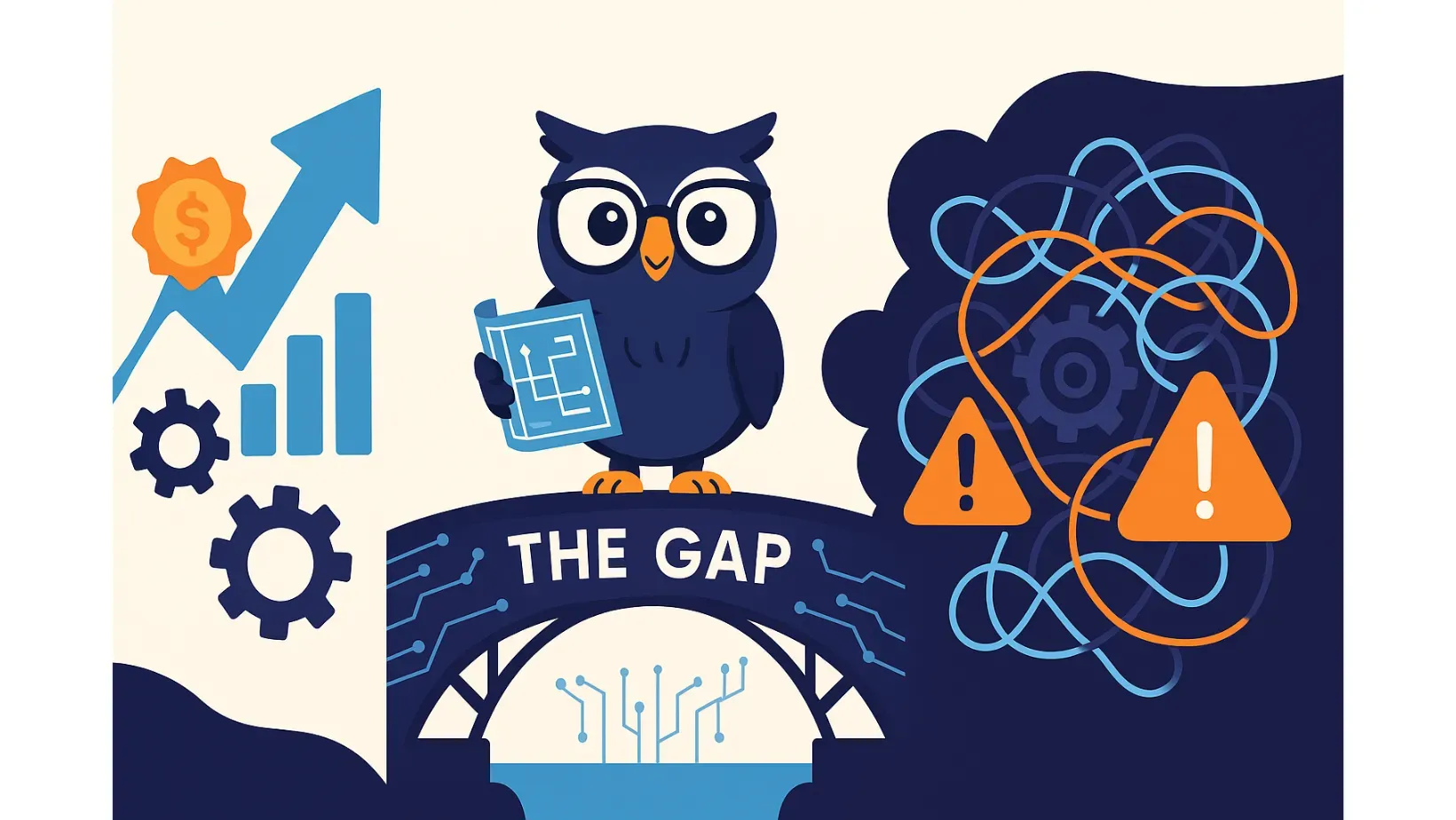
And while that is very true, a vast majority—estimates suggest over 85% of enterprises—that explore AI, fail. They get nowhere, or they get chaos and their projects stall.
At PromptOwl, being one of the few shops that specialize in completely custom, enterprise, we‘ve seen the aftermath of past failures firsthand. Often, our clients reach out after they’ve spun their wheels and stalled pilot project. They all realized they met their limits and needed a partner to guide them. In short, they needed someone to help them navigate the gap between initial enthusiasm and operational reality.
I wanted to share some key takeaways about what it truly takes to bridge that gap. My hope is to save some of you from the normal pitfalls, and if you are going to need help, to understand why and get that help earlier.
They say fail fast—and its even more important with AI. Do not forfeit your competitive advantage if you don’t have to.
Design for Reality, Not the Demo
An early lesson for me was the need to shift focus. Initially, the emphasis might be on proving a core AI concept works in isolation. That can be the fun bit—to tinker and ideate.
However, designing for production realities from the start is essential. Focus on what actually provides value may not be fancy, but it should be effective and compliant. Often, selecting fewer, high-impact use cases with a clear integration path is often more effective than pursuing the most technically novel idea without one.
The Model is Expendable
The rapid advancements in LLMs are exciting, and exploring different models is part of the process. However, a key realization, reinforced by our work at PromptOwl, is that the model itself is just one piece of a larger puzzle. And better ones keep coming out. We expect there to be a proliferation of specialty models in the future, and you need to design to be nimble.
This means the surrounding system — the data pipelines, the integration points, the infrastructure, the user interface — is what ultimately solves the problem. A well-engineered system that can rapidly adapt and compare performace of models, and work with broad types of AI workloads is often far more valuable than a state-of-the-art model hampered by a weak implementation.
Foundational Data Quality
AI performance hinges entirely on the data it’s trained and run on. Many significant project hurdles we’ve encountered trace back to data challenges — accessing it, cleaning it, ensuring its quality and relevance. It’s become abundantly clear — poor data inputs inevitably lead to ineffective or unreliable AI outputs. Every organization, including PromptOwl, possesses unique institutional knowledge within its data. Unlocking that requires a serious, often unglamorous, commitment to data governance, quality improvement, and accessibility. Addressing the core challenge of noisy, complex data is paramount for differentiated value.
Operationalizing Is Non-Negotiable
Successfully launching an AI system isn’t the finish line. It’s the start of an ongoing process. Production AI requires continuous monitoring, maintenance, learning, and retraining to adapt to changing data and conditions. This operational discipline often termed MLOps isn’t just jargon. It’s crucial for sustained performance and reliability. It’s an ongoing commitment.
You can outsource this though. If you don’t have someone capable of ML Ops, I recommend you do.
The Human Element and Mindset
Often, the technical aspects, while complex, are more predictable than the human factors. Integrating AI successfully means addressing how it impacts people and workflows. Concerns about job roles or trust in the technology are natural. Addressing these requires transparent communication, articulating how AI augments their own capabilities, making them more productive and effective, and incorporating safeguards like human oversight.
But this goes beyond just training people on a new tool.
True adoption requires the leadership to be invested in its strategic success, and to embrace principles core to digital transformation — adaptability, data-driven decision-making, cross-functional collaboration, and process flexibility. Integrating AI effectively isn’t just a tech upgrade. It’s a cultural shift that requires understanding how work changes and empowering people within that new context.
Measure Real-World Impact
Initial ROI projections during pilots are useful, but production AI requires measuring sustained, real-world impact. This means looking beyond just potential cost savings or revenue lift. It includes improvements in employee productivity, decision quality, customer satisfaction, and understanding the total cost of ownership — including infrastructure, data management, talent, and ongoing operations.
Transitioning AI from a promising concept to an integrated, value-driving capability is a significant organizational undertaking. And it needs to be part of the pilot. It demands careful strategic planning, a persistent focus on data fundamentals, thoughtful change management grounded in digital transformation thinking, investment in operational readiness, and a commitment to measuring tangible results.
Crucially, none of this happens in a vacuum. Sustained commitment and active involvement from leadership are essential to provide the resources, mandate, and strategic alignment needed to navigate these complexities successfully. The difference between a stalled pilot and impactful production AI often lies less in the raw technology itself, and more in the commitment to the endeavor.
Adding to the complexity is the sheer speed of change in this field. AI is evolving at lightspeed compared to previous technology waves. Staying current and ensuring projects start on the right footing is critical — which is why partnering with specialists focused exclusively on navigating this landscape can be invaluable for setting the right direction from the beginning.
Moving Forward
Let’s focus our conversations not just on the potential shown in demos, but on the practicalities of building and sustaining AI that truly works in the real world.
Navigating the path from promising AI pilot to robust production system is the core challenge we’ve explored here. At PromptOwl, our focus is squarely on helping organizations bridge this exact gap. We partner with teams to tackle these common hurdles, significantly increasing the probability of successfully deploying AI projects that deliver real value. If tackling these challenges resonates with your current situation, consider reaching out to our AI Talent Consultation. It’s free!