“Two of our agents told people different things.”
Why it happensEach agent has its own copy of the instructions and documents. The copies drift apart, and neither agent knows the other exists.
Usually starts at the second agent
Today your AI learns from a drive, a wiki or a pasted brief that no one approved. ContextNest gives every AI the same approved company knowledge and records every read, so you can rebuild what it knew on any date.
One person, one agent, their own copy of the policy. It works, because it's theirs.
Works with the AI tools you already have.





“Two of our agents told people different things.”
Usually starts at the second agent
“It was brilliant on my laptop and dumb in production.”
Starts when it leaves one machine
“An agent read something it was told to stay out of.”
Critical once agents face clients
Where it breaks: Search gets worse as files pile up, old versions answer questions, and an agent using your connector can open everything you can.
Full comparison →Keep it in the assistantWhere it breaks: Great for one person. Tied to one vendor and one account, and it leaves when that person leaves.
Full comparison →Plug memory into the agentWhere it breaks: Quick to add to one app. The agent writes its own memories, and nobody approves what it keeps.
Full comparison →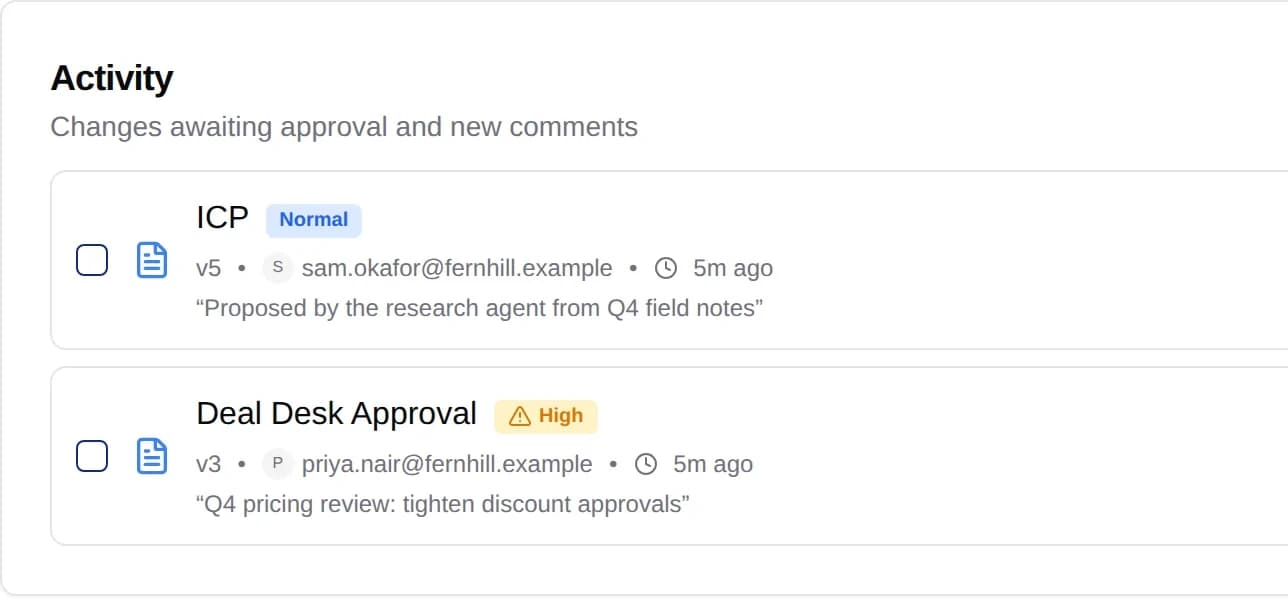
ContextNest Community 1.28, fictional demo company.


Agencies, consultancies and fractional practices. Build your method into AI once, under your brand, and deploy it to every client. Run your own firm on it first.

Your members already come to you for what you know. Turn it into an assistant that answers from your approved material, under your brand.

Whether something just went wrong or you've been handed an AI-first mandate, govern one team first and scale when your requirements say so.

One governed source every agent reads from: versioned, approved and model-agnostic. Point your existing agents at it without a rewrite.
Pick a team and start from its own knowledge.
Build the governed context your team's AI should already have, with every change versioned and every read recorded from day one. Works with Claude, Cursor and any MCP client.
ContextNest is governed context for your AI: your company's knowledge as structured, graph-linked Markdown, versioned and approved by the people who own it. Any MCP-compatible AI (Claude, Cursor, Antigravity) reads directly from it, so every tool works from the same approved version. The Desktop app is free and runs locally. Patent pending.
ContextNest handles living knowledge: structured, versioned, human-approved documents your AI reads directly, so the same question pulls the same context every time. RAG handles static knowledge: retrieval over large corpora that rarely change. PromptOwl governs both. Our research preprint (not peer reviewed), with co-authors from IBM Research and Emory University, measured a 97% answer pass rate versus 90–93% for keyword search (BM25) in a stale-version test, at about a third of the input tokens.
Read the whitepaper →The ContextNest CLI, engine and MCP server are open source (AGPL-3.0) and free. Install the CLI and it runs locally against your Markdown vault. The team workspace is free for up to 10 users, on our cloud or your servers. Hosted is $10 per user per month on our cloud. Self-Hosted is $10 per user with a 30-user minimum, unlimited storage and no overage bills. Every paid plan starts with a free month. Enterprise is custom, on one annual contract. Your own AI tools reading a nest over MCP never use credits. Credits only apply when PromptOwl supplies the model.
Every plan runs on the same SOC 2 and HIPAA controls. SOC 2 certification and reporting and a HIPAA BAA come with Enterprise. Role-based access, approval before AI may use a document, and a record of every read are part of the product.