Find your problem

Find the sentence your team has already said out loud.

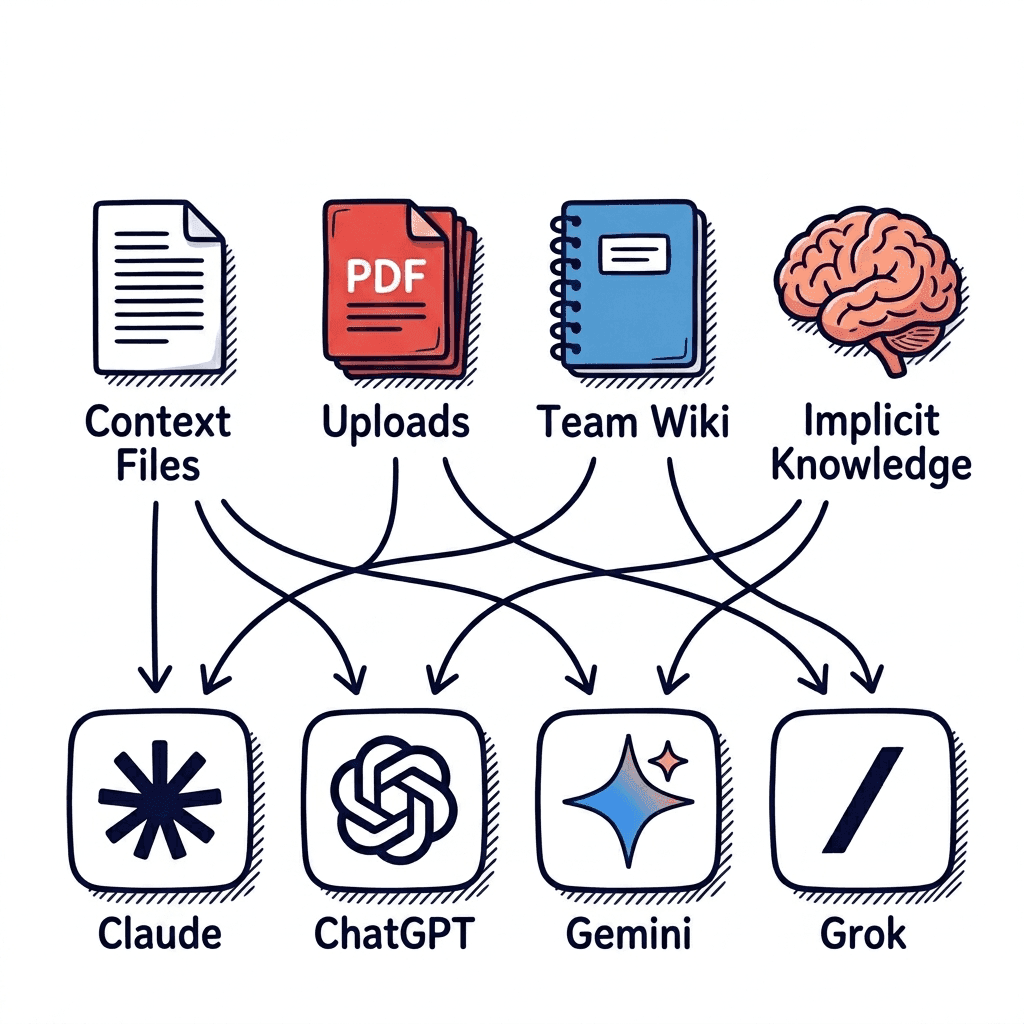
These are the things leaders say when AI starts to spread across a company. They look like different problems. They come from one place: the company's knowledge has no governed home that every agent reads from.

Showing all 11

Wrong or inconsistent answers

“Two of our agents told people different things.”

Why it happensEach agent has its own copy of the instructions and documents. The copies drift apart, and neither agent knows the other exists.
What fixes itOne approved source that both agents read. Update it once and every agent picks up the change.

Usually starts at the second agent
Pilot to production

“It was brilliant on my laptop and dumb in production.”

Why it happensOn your laptop the agent had your logins, your files, your history and no time limit. In production it gets narrow credentials, a time limit and none of what it had learned.
What fixes itKeep the knowledge outside the agent. Any runtime, on any machine or model, reads the same governed context, so moving the agent doesn't mean starting over.

Starts when it leaves one machine

Access and risk

“An agent read something it was told to stay out of.”

Why it happensWriting “don't touch client data” in a prompt is a request. If the agent can reach the folder, it will open it eventually and apologize afterward.
What fixes itScope by role before anything is retrieved. An agent can't fetch what it isn't allowed to see, so nothing depends on it following instructions.

Critical once agents face clients

Proof and audit

“We can't show what the AI was working from last quarter.”

Why it happensThe documents changed, nobody kept the old versions, and nothing says which one was approved at the time.
What fixes itRecord every read (which person or API key, which document, and when) and keep every approved version, so you can rebuild what the knowledge said on any past date.

Legal or a customer asks first

Wrong or inconsistent answers

“It answered from last year's policy.”

Why it happensNothing marks a document as current or retired. The old version is still in the folder and still matches the question.
What fixes itVersion and approve what agents may use. A retired document stops being eligible, even though the file still exists.

Regulated teams hit this early

Wrong or inconsistent answers

“Search got worse as the drive grew.”

Why it happensMore files means more duplicates, more drafts and more near-matches. The agent retrieves whatever looks closest, and runs get longer and more expensive.
What fixes itDistill the drive into a curated, approved set that agents read. The drive stays as storage, and agents only see what they need.

Grows with headcount

Pilot to production

“Our pilot works. We can't roll it out across teams.”

Why it happensThe pilot's knowledge was hand-fed by the person who built it. Each new team would need that person to do it again.
What fixes itA shared layer that each team adds to, with named owners who approve their own area. New teams start from what's already there.

Starts at the second team

Lock-in and turnover

“Switching models means re-teaching everything.”

Why it happensThe context lives inside one vendor's projects or memory. It doesn't come with you when you switch.
What fixes itKeep context in files the company owns, readable by Claude, Cursor and whatever comes next.

Every model change

Lock-in and turnover

“When someone leaves, their AI setup leaves with them.”

Why it happensPrompts, projects and saved context sit in personal accounts. What that person taught the AI was never the company's.
What fixes itCompany-owned context with a history of every change. Knowledge stays when people move on.

The first departure

Cost and pressure

“Our AI bill keeps climbing.”

Why it happensAgents re-read far more than they need on every run, and cloud runs are metered.
What fixes itGive each agent only the approved context its job needs, so it stops paying to dig through everything on every run.

When the subsidy ends

Cost and pressure

“The CEO says go faster. Every vendor is selling a magic rock.”

Why it happensSpeed stalls when someone finally asks “are we allowed to do this, and is the answer right?” Without approval rails, each new tool reopens that question.
What fixes itApproval and scoping that sit under every tool. Teams move faster because the rules are set once, and you aren't betting the company's knowledge on one vendor.

Every board meeting

When it starts to hurt

Most teams climb this ladder in order.

Some leaders see the top from the bottom rung because they've been through it before. If that's you, start here.
  1. Step 1

    The first agent

    It works. Its knowledge lives in one person's prompts and files.

    Works: Nothing breaks yet.

  2. Step 2

    The fifth agent

    Agents start to disagree, and nobody knows which document is current.

    Starts to strain: Inconsistent answers, stale policy.

  3. Step 3

    The second team

    Sharing means copying, and permissions start to matter.

    Starts to strain: The pilot won't scale. Restricted data leaks.

  4. Step 4

    A second model or runtime

    Moving to the cloud, a web app or another model leaves context behind.

    Breaks: Laptop to production, lock-in, cost.

  5. Step 5

    The client-facing agent

    A wrong answer is now a liability. You have to show what the agent used, and never mix one client's data with another's.

    Breaks: Audit, access, trust.

One cause

These symptoms share one cause.

Each one traces back to what the model was given. Fix where the knowledge lives, who approves it and who may read it, and these symptoms stop arriving one at a time.

Context files, uploads, a team wiki and unwritten knowledge each feed Claude, ChatGPT, Gemini and Grok separately, with crossing arrows.

Fix the one you recognized first.

Start free and connect the AI your team already uses, or book a demo on documents like yours.