
Originally published in The Generator.
I have been a writer for years—for big companies like VMware, Pivotal and American Eagle Outfitters.
Over the past 2 years, I have embraced AI to radically improve my content quality and production capabilities. Today, about 80% of my content starts its life as AI-generated text. But there’s a critical distinction between what the AI spits out and what finally gets published under my name.
The difference? My voice. My perspective. My hard-earned expertise.
Last week, someone told me they could “always tell when content is AI-written versus human-written.” I smiled, knowing they’ve regularly been reading pieces of mine that began as AI drafts. In 2025, the secret isn’t avoiding AI tools — it’s knowing how to use them effectively.
Why Most People’s AI Revision Process Falls Short
I’ve spent the past year refining my AI-to-authentic content pipeline, and I’ve noticed most people make the same critical mistake: they don’t take the time to work a system. They treat AI output as nearly finished content that just needs a quick polish.
That approach is exactly why so much online content now has that same bland, oddly formal AI voice peppered with crazy amounts of emojis that we’re all beginning to recognize.
The trick is to take that generic bot-speak, and transform it into a real person’s voice.
How I Turn Robot-Speak Into Stacey-Speak
Let me walk you through my real workflow, including the tools, prompts, and techniques I use to ensure my content maintains its authenticity.
Step 1: Create a Baseline Draft
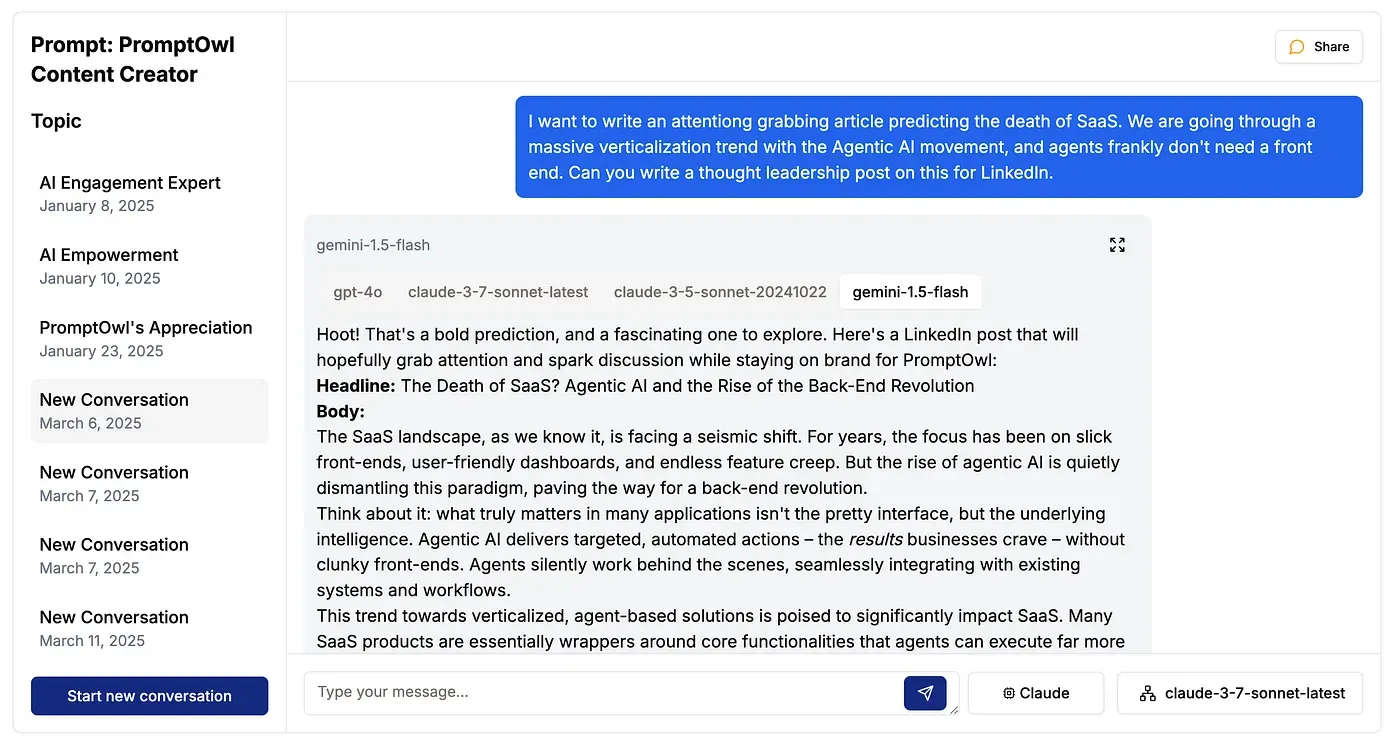
My prompt to start the article.
When I start a piece like my recent Death of SaaS article on LinkedIn, I don’t just throw a vague prompt at ChatGPT. I use a prompt management tool like PromptOwl that is primed with specific context from my company.
- My company messaging
- Target audience profiles
- Existing content on similar topics
This context-loading step is crucial — it gives the AI the information it needs to generate something at least pointed in the right direction. It means every time I go to ask AI something, it already knows the important guidelines. Without it, you’re just getting generic outputs that could belong to anyone.
The first draft is usually structurally sound but lacks personality. It definitely sounds like a bot wrote it, but that’s OK. At least for this stage of the process.
Step 2: Model Switching for Better Results
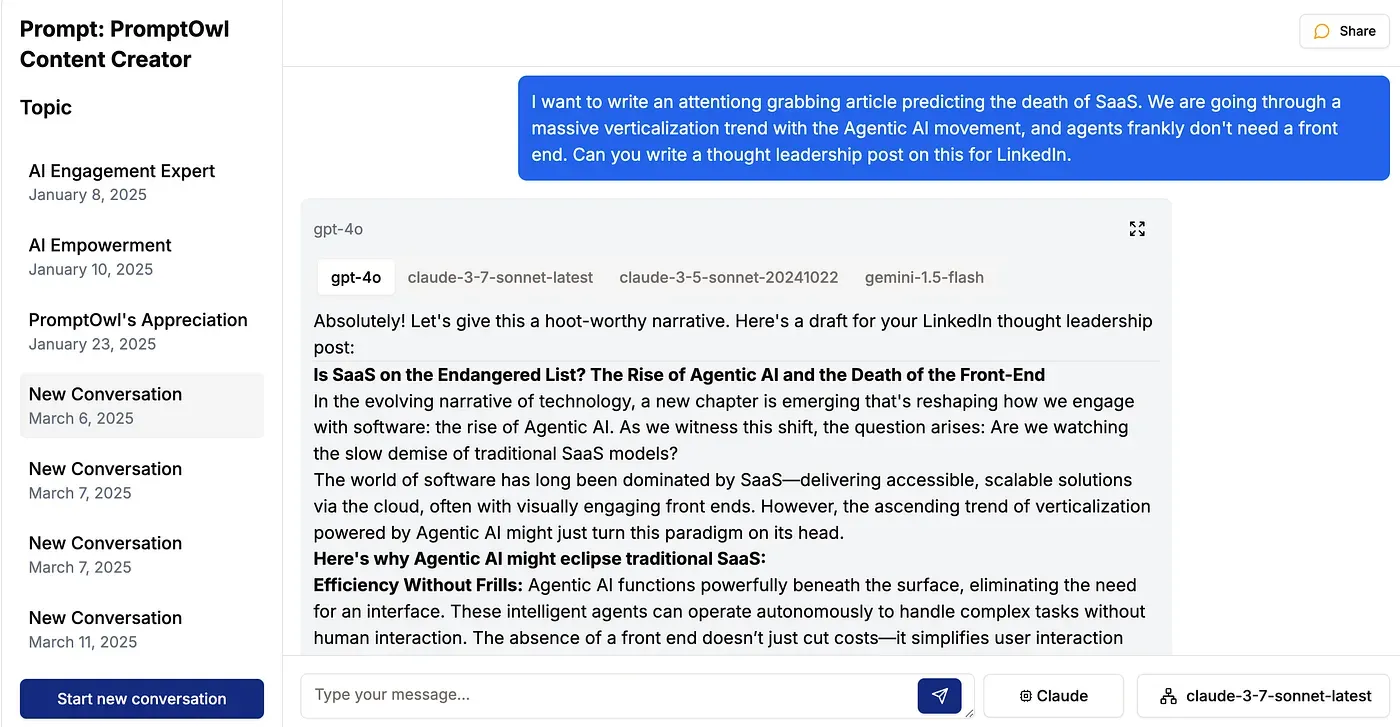
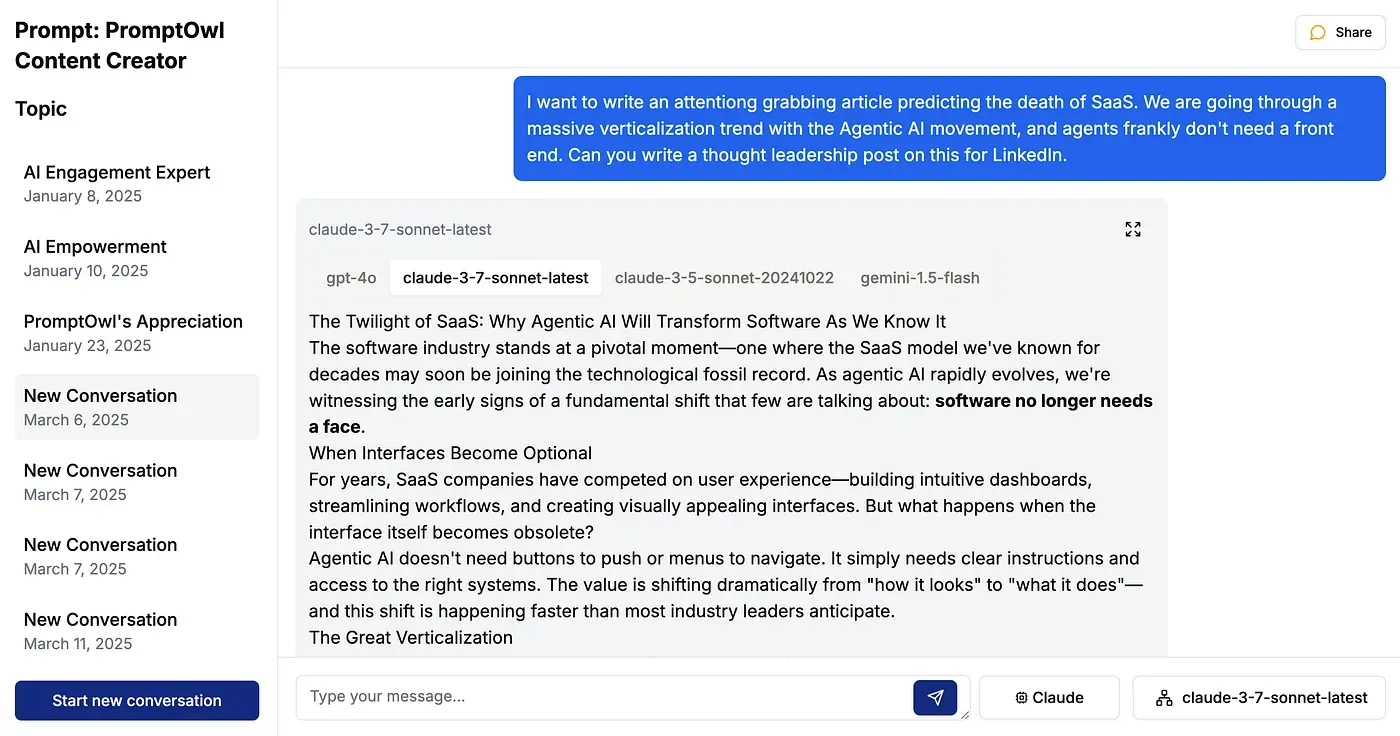
Comparing answers between ChatGPT 4o and Claude 3.7 Sonnet.
This is the first ingredient in my special sauce: I use about 7 models regularly, running requests through each and comparing their results.
Different LLMs have different strengths, and while I may think that some are usually going to give me better results—I am surprised often enough that I still go through the process of checking each.
Most of the time, its a combination of LLMs that gets me to my first draft. For my Death of SaaS article, I merged results from Claude and Gemini for the main content and Llama specifically for creating social promotion posts.
Using PromptOwl’s AI switching capability, I run the same content through different models and cherry-pick the best elements from each. This #BattleOfTheBrains approach yields significantly better results than relying on a single model.
Regardless, the resulting draft still stinks of bot-speak. So here’s where my second bit of magic comes in.
Step 3: Run it Through the Stacey Writer Prompt
Just as I had a company content writer that knew the specifics of our messaging, now I turn to a prompt that has been built to write like me.
I built this prompt by harvesting about a dozen long-form pieces I’d written over years (including several from Medium!). I exported them into PDFs, and then loaded them into various LLMs, and asked them to articulate my writing style. Again, I aggregated the results of several LLMs to get a good balance in my prompt.
Using their own descriptors for my style, I loaded them in as instructions into the Stacey Writer prompt to create a detailed blueprint of my actual writing patterns.
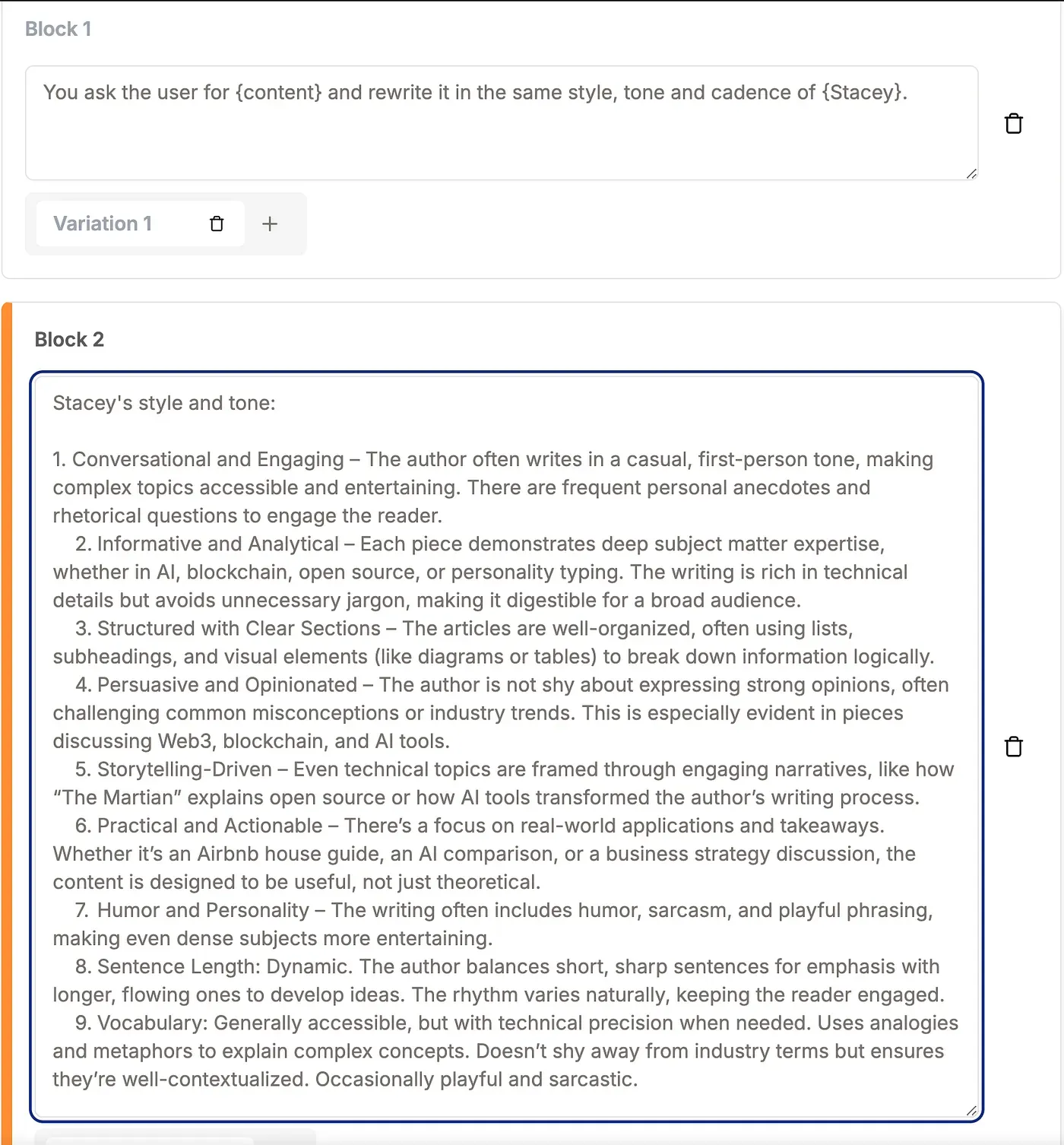
The Stacey Writer prompt.
Step 4: The Critical Human Edit — Facts, Voice, and Flow
Once I have an AI draft that’s been run through my voice model, I edit for four critical elements:
- Fact Check Everything: I never trust a fact from an AI. For my SaaS article, the AI confidently cited about a half dozen statistics that sounded plausible but needed verification. In this case, none of them were verifiable. They were all hallucinations. So, I had to search for replacements and adjust accordingly.
- Voice Consistency: Even with my detailed voice prompt, certain phrases still feel AI-ish or too corny. Even worse, the various AIs fabricated some experiences for me—like a conversation with a fictional healthcare executive. So, I needed to root these out and ground all the references and language in real talk and reality.
- Flow Adjustment: AI tends to create evenly-paced content. As a writer, I deliberately break this pattern, creating more dynamic rhythm by varying sentence length, adding occasional one-line paragraphs for emphasis, and ensuring ideas build logically. For the most part, the Stacey Writer did a good job of this, but I still always find I want to change the paragraph organization, or vary sentence lengths even more.
- Add Personal Experience: This is crucial — I insert specific experiences and insights the AI couldn’t possibly know. Rooting out fabricated experiences isn’t enough, you do need to inject real world color that only you can add. For the SaaS piece, I added my firsthand observations from working with clients who were shifting from traditional SaaS to agentic models.
Your Turn: Building Your Revision Process
If you’re using AI to draft content (and let’s be honest, most of us are), here’s my challenge: invest the time to create your own detailed voice model. Don’t just edit AI content — transform it.
Remember, the goal isn’t to hide that you use AI tools — it’s to ensure they enhance your authentic voice rather than replace it. Your readers don’t care what tools you use. They care whether your content delivers value in a voice they connect with.
AI can help you create more content, but only you can make that content truly yours.
Got questions about my AI content revision process? Drop them in the comments!