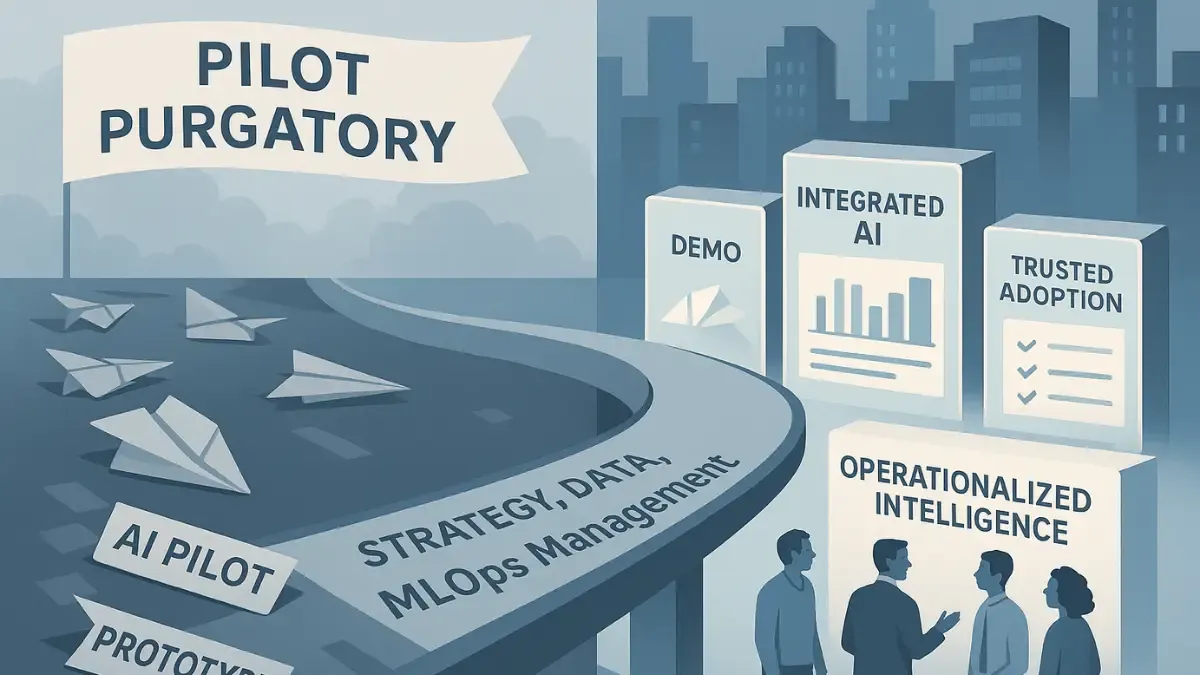
Many organizations jump into AI with promising pilot projects, showcasing early wins and generating hype. But here’s the brutal truth: Most of these pilots are FAILURES if they never make it to full-scale production. They languish in “pilot purgatory,” delivering isolated insights without ever driving enterprise-wide impact or truly transforming operations.
Why does this happen? Because scaling AI is not just a technical checkbox—it’s a fundamental ORGANIZATIONAL TRANSFORMATION. The complexity of integration, data readiness, talent gaps, and cultural resistance consistently derail promising initiatives. Over 85% of enterprises may be exploring AI, but a staggering majority struggle to make it actionable, with only 15% successfully deploying solutions. This isn’t just a missed opportunity—it’s a strategic liability.
The time for dabbling is over. To escape pilot purgatory and unlock the real ROI of AI, you must bridge the gap between experimentation and execution with deliberate, aggressive action.
Phase 1: Start Smart, Not Just Small
Yes, begin with pilot projects or MVPs to test feasibility and learn. But DON’T design for the pilot—design for production from DAY ONE. Select fewer, high-impact use cases that directly align with core business objectives and have a clear path to P&L impact. Meticulously define scope and success criteria before you start.
Phase 2: Validate Ruthlessly at Scale
A successful pilot is merely permission to proceed. Before you scale, PUT YOUR AI SOLUTION THROUGH HELL. Evaluate its readiness beyond the model:
- Performance: Does it crumble under real-world data loads and conditions?
- Integration: Can it SEAMLESSLY plug into your existing, messy legacy systems? This requires selecting AI tools with strong API capabilities and planning integration early.
- Adoption: Will your people actually use and TRUST it? This isn’t optional—it’s driven by proactive change management and addressing fears head-on.
Governance: Have you built in ethical considerations, bias mitigation, security, and compliance from the ground up? Responsible AI is non-negotiable.
Phase 3: Operationalize and Embed
Successful scaling requires embedding intelligence directly into your everyday tools and processes. This isn’t about standalone AI dashboards—it’s about fundamentally redesigning workflows to leverage AI capabilities.
- Implement MLOps: YOU NEED Machine Learning Operations. This isn’t optional tech jargon—it’s the framework for continuous monitoring, maintenance, retraining, and evolution that keeps your AI effective and sustainable. AI is an ongoing operational commitment, not a finished project.
- Address the Data Monster: Data is the fuel, and if your fuel is dirty, your engine WILL fail. Poor data quality, silos, and access issues are fundamental bottlenecks. Invest HEAVILY in data governance, cleansing, integration, and infrastructure BEFORE you attempt to scale. Leverage AI itself for data management tasks. Your internal data is your competitive “moat” – unlock it.
Phase 4: Measure What ACTUALLY Matters
Stop fixating solely on simplistic, short-term ROI. The true value of AI Transformation (AIT) spans both tangible financial gains AND critical intangible benefits.
- Define Clear KPIs: Set specific, measurable objectives and Key Performance Indicators BEFORE you start.
- Track Holistically: Measure cost savings, revenue growth, AND employee productivity, customer satisfaction, decision quality, and innovation capacity.
Account for Total Cost: Be meticulous in tracking initial costs, infrastructure, data prep, talent, training, and crucially, ongoing maintenance and cloud consumption.
The Bottom Line:
Moving from AI pilot to production is an organizational imperative, demanding strategic clarity, data readiness, proactive change management, investment in talent, robust governance, and a commitment to continuous improvement. The vast majority of invested capital ($327.5 billion globally) is currently trapped in hype and unrealized potential because companies fail at this transition.
Lead with proactive change management. Communicate transparently, address fears (like job security concerns) openly, highlight benefits for employees (freeing up time for higher-value work). Secure visible leadership commitment and demonstrate the “why”. Empower employees with the skills to work with AI, not be replaced by it. Foster a culture that embraces data and experimentation.
Organizations that adopt these principles – prioritizing strategy, mastering data, leading change, operationalizing with MLOps, and measuring value holistically – will break free from pilot purgatory and establish AI as a CORE, COMPETITIVE CAPABILITY. Anything less is a waste of time and money. Don’t just build AI—build a truly AI-driven organization.