Late last year, a Fortune 500 CTO pulled me aside at a conference, his expression a mixture of frustration and fatigue.
This isn't an isolated incident. He's not alone. According to recent enterprise surveys, a staggering 73% of AI pilots never reach production deployment. This isn't primarily a technology problem. It's a fundamental strategy problem, one that PromptOwl frequently observes organizations grappling with.
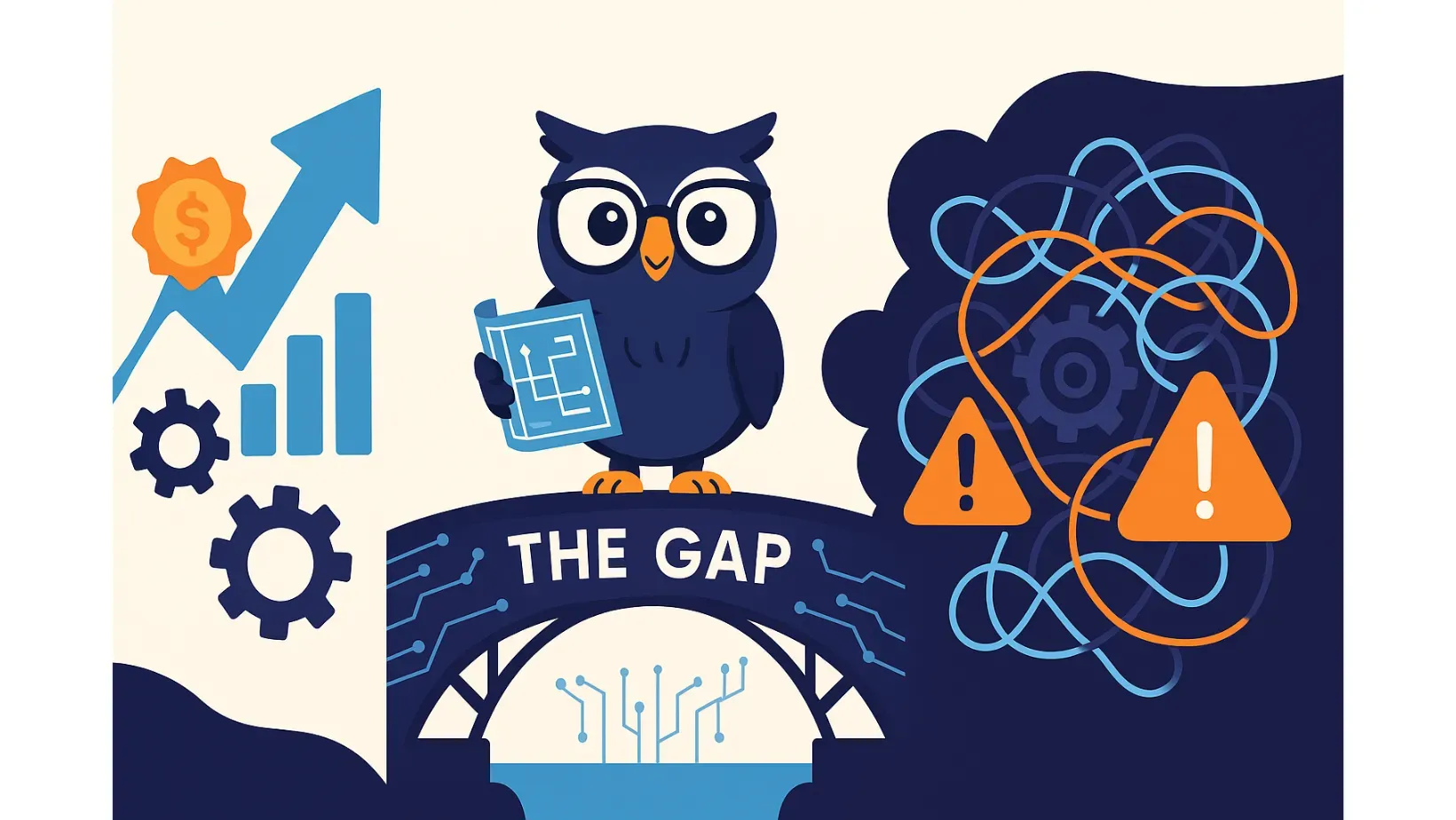
The most expensive mistake CXOs make isn't picking the wrong AI tools. It's treating AI agents — these dynamic, learning entities — like traditional, static software projects. This misjudgment leads directly to the "Pilot Trap."
The Pilot Trap Playbook (And Why It Fails Every Time)
Here's how the all-too-common pilot trap ensnares well-intentioned teams:
This cycle is a familiar narrative in boardrooms and innovation labs. The core of the trap lies in attempting to define an AI agent's behavior exhaustively upfront, much like blueprinting traditional software. But intelligent agents aren't static workflows. They are dynamic systems designed to learn, adapt, and evolve.
When organizations try to lock down every decision tree before an AI agent interacts with the real world, they are essentially building expensive, brittle chatbots that falter the moment they encounter the unexpected — which, in real-world scenarios, is inevitable.
The Hidden Costs of Chasing Perfection
PromptOwl has witnessed companies spend 18 months or more "perfecting" an AI agent in a sterile lab environment before allowing it anywhere near real customer data. By the time these agents are theoretically deemed "ready," the business requirements have shifted, the underlying technology has advanced, and often, the original project team has been reassigned, their enthusiasm waning.
Meanwhile, their more agile competitors deployed imperfect-but-functional agents, embraced real-world interactions as a data source, and iterated their way to robust solutions that deliver tangible value.
The cost isn't just the wasted pilot budget. It's the crippling opportunity cost: the market share lost, the operational efficiencies ungained, and the innovation momentum forfeited while an organization remains stuck in an endless loop of planning and re-planning.
A Strategic Framework for Scaling AI That Actually Works
Successful AI transformations, the kind PromptOwl champions and implements, follow a radically different playbook. It's about iterative deployment, rapid learning, and adaptive growth, supported by robust platform capabilities.
Deploy Small, Learn Fast
Action
Start with a highly specific, narrow use case where mistakes are low-cost learning opportunities. Deploy an agent with foundational capabilities and clearly defined operational boundaries.
Goal
The objective here isn't perfection. It's data acquisition and initial learning. This involves capturing a rich stream of data from day one.
PromptOwl's Guidance
PromptOwl helps clients identify these initial use cases and deploy agents with mechanisms like read-only access or, crucially, a human-in-the-loop (HITL) for oversight. This HITL function is vital for correcting the agent and accelerating its learning curve.
Iterate Based on Reality
Action
Analyze the rich, raw data collected. This isn't just about surface-level metrics — it's about deep dives into agent "thinking traces" to understand decision-making and debug prompts.
Goal
Data-driven refinement. Add tools, knowledge, and capabilities based on observed needs, not hypothetical scenarios.
PromptOwl's Guidance
PromptOwl establishes robust analytical frameworks to identify common failure points, understand user pain points, and discover patterns in successful interactions.
- Prompt Improvement: Iteratively refining prompts using versioning and A/B testing.
- Knowledge Augmentation: Systematically expanding the agent's knowledge base.
- Tool Integration: Connecting agents to necessary tools as observed needs dictate.
Expand Gradually and Intelligently
Action
Once the agent demonstrates reliability, strategically and gradually expand its responsibilities. "Reliability" means consistently achieving >90% accuracy on core tasks.
Goal
Scale value systematically. As trust is built, the agent's impact grows, progressing through defined levels of autonomy.
PromptOwl's Guidance
PromptOwl provides the roadmap for this controlled expansion, ensuring that monitoring and feedback loops continue to drive evolution.
The Questions Every CXO Should Ask Their Team Before the Next AI Pilot:
- ?"What is our absolute minimum viable deployment that allows us to learn in a real environment?" (Hint: It's probably smaller than currently imagined.)
- ?"How will we measure learning and adaptation, not just static performance metrics? What specific data points will we collect from day one?"
- ?"What is our rapid iteration cycle? Are we thinking in terms of weekly reviews and refinements, not quarterly reports?"
- ?"What is our failure management plan? What happens when the agent errs, and how does our human-in-the-loop strategy support correction?"
From Marketing Pilot to Campaign Success in 90 Days
Consider a marketing department bogged down by drafting emails. After failed ambitious pilots, they pivoted to a simple AI agent for drafting one specific segment's emails, with human oversight.
Agent generated drafts requiring significantly less editing time.
A/B testing showed subject lines improved engagement by 25%.
Agent autonomously drafting for three segments, freeing 15 hours/week.
The Bottom Line: Deploy, Learn, Scale
AI agents are not traditional software projects. They are living systems that thrive on real-world interaction and data to mature and improve. The enterprises truly winning with AI aren't those with theoretically perfect pilots gathering dust. They are the ones courageously deploying imperfect-but-valuable agents and making them demonstrably better, week after week.
Your next AI project doesn't need to be perfect.
It needs to be deployed.
Stop planning the perfect agent. Start building the learning one.