The race to deploy AI is producing some genuinely impressive results. Models are getting smarter. RAG systems are getting more sophisticated. Agents are becoming more capable.
But here's what's becoming clear: the difference between AI that delivers lasting value and AI that becomes technical debt isn't about the model you choose or how many documents you've ingested. It's about the architecture underneath—the invisible operating system that determines whether your AI can evolve alongside your business.
That invisible layer is the Control Plane. And it's the difference between building something that works today versus building something that keeps working as the world changes around it.
The Stack Everyone Ignores
Misha Sulpovar, SVP & Head of AI at Cherre and Wise Owl Strategic Advisor to PromptOwl, lays out the framework in his new book The AI Executive: Harnessing the Ungoverned Machine. Most organizations miss what matters entirely—everyone obsesses over models or data. But the leverage sits somewhere else: the layers that determine how AI actually behaves when no one's watching.
- Data LayerThe custody of truth. Messy data doesn't just frustrate, it poisons everything downstream.
- Context LayerWhere organizational intent lives. Your policies, your tone, your acceptable error rates. This turns eloquent nonsense into trusted intelligence.
- Orchestration Layer (The Control Plane)Control, governance, and reliability. This is where escalation paths get enforced, permissions get checked, and human oversight gets triggered.
- Model LayerThe brilliant, commoditizing engines. Critical inputs, but not moats.
- Application LayerThe glass and the glue. Apps don't vanish, but they stop being the front door. The agent takes that role.
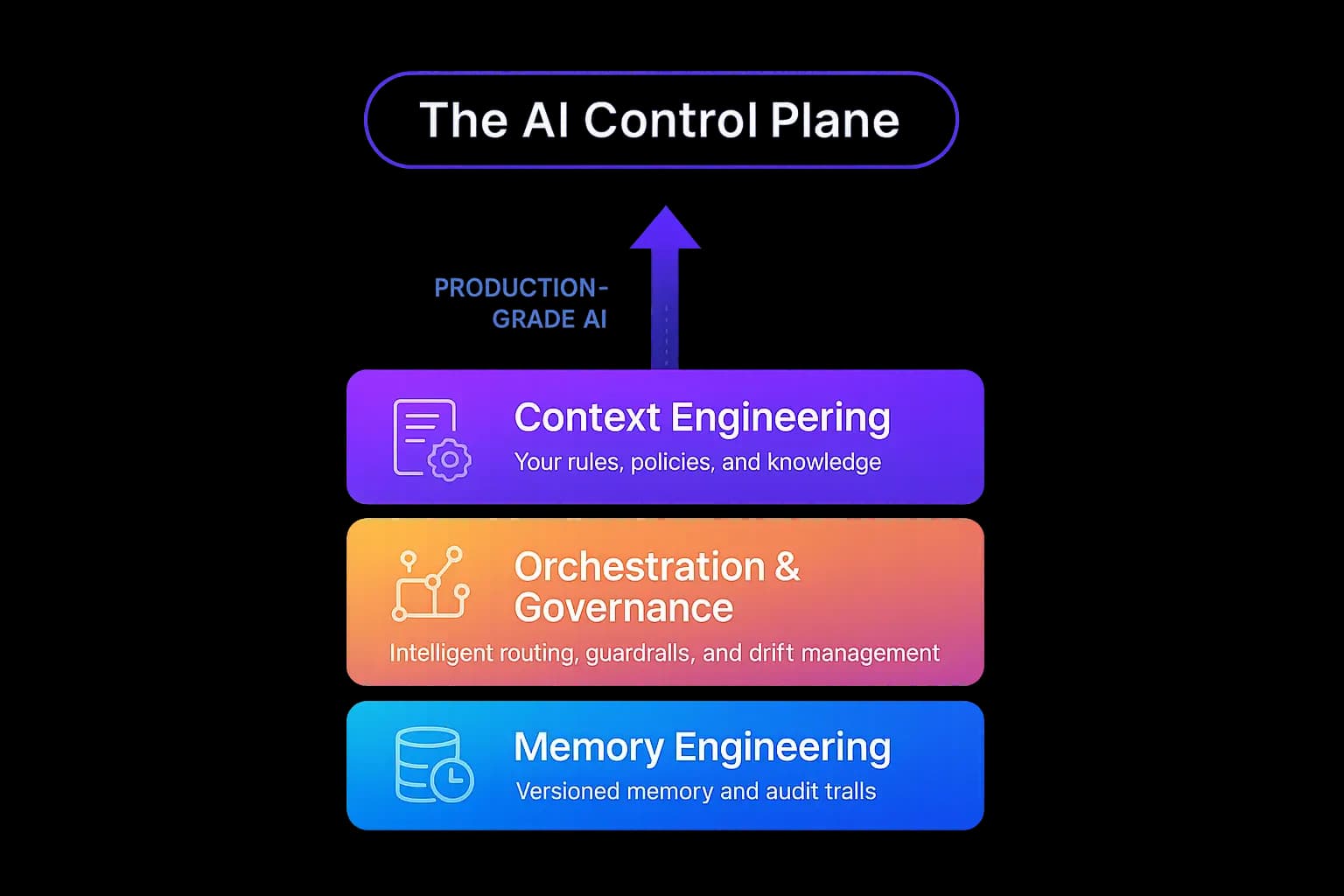
Pillar 1: Context Engineering — Your Proprietary Competitive Edge
The model doesn't know your escalation paths. It doesn't know your regulatory risk tolerance or your acceptable error rate. It doesn't remember last quarter's strategy.
That's context. And as models become increasingly commoditized, context becomes your differentiator. Even modest models, when paired with curated context, can outperform by producing work that is accurate, timely, and trusted.
The Stakes Are Real
- Customer Service: With curated context, AI systems can handle up to 75% of inquiries autonomously.
- Healthcare: Mass General Brigham saw a 40% reduction in after-hours documentation when ambient AI scribes were properly integrated with clinical protocols.
- Legal: Systems built with proper grounding prevent "hallucinated" case citations—a growing risk for unmanaged AI.
Pillar 2: Orchestration & Governance — The Engine of Stability
Context guides intelligence. Orchestration enables it to scale reliably. Think of orchestration as air-traffic control. The tower decides who takes off when, where they land, and how close they're allowed to fly.
For the compliance officer, orchestration is the filter that runs every AI-drafted memo through policy checks. For the developer, it's the integration harness. For the CEO, it's the audit trail.
There is no "fully autonomous" enterprise AI. The point isn't to remove humans—it's to put them back in at the right moments. Orchestration means encoding escalation paths into the architecture.
Pillar 3: Memory Engineering — The Abstraction Engine
The most sophisticated AI systems don't just perform tasks—they improve from experience. This requires engineering memory and feedback loops into the architecture from the beginning.
Traditional software handles updates manually. AI systems compound by building feedback loops that turn operational data into system improvements. The systems that thrive treat continuous learning as an architectural requirement, not a maintenance task.
- Systematic Feedback Collection: End-users need a way to mark what's working and what isn't as part of the operational workflow.
- Self-Evaluating Metrics: Automated evaluations that establish baselines, identify drift, and flag outliers.
- Versioned Memory as Audit Trail: Everything needs to be reproducible for compliance and learning.
Building for Evolution
The hard part isn't making AI smarter. It's making it governable, reliable, and capable of evolving alongside the business. Context needs curation. Orchestration needs oversight. Memory needs feedback loops.
The Control Plane acts like the foundation of a skyscraper. You don't see it when you admire the top floors, but without that engineered bedrock, the building couldn't reach for the sky.
Ready to see the Control Plane in action?
PromptOwl was built around these principles—context engineering, orchestration, and self-evolving systems.
Explore the Platform