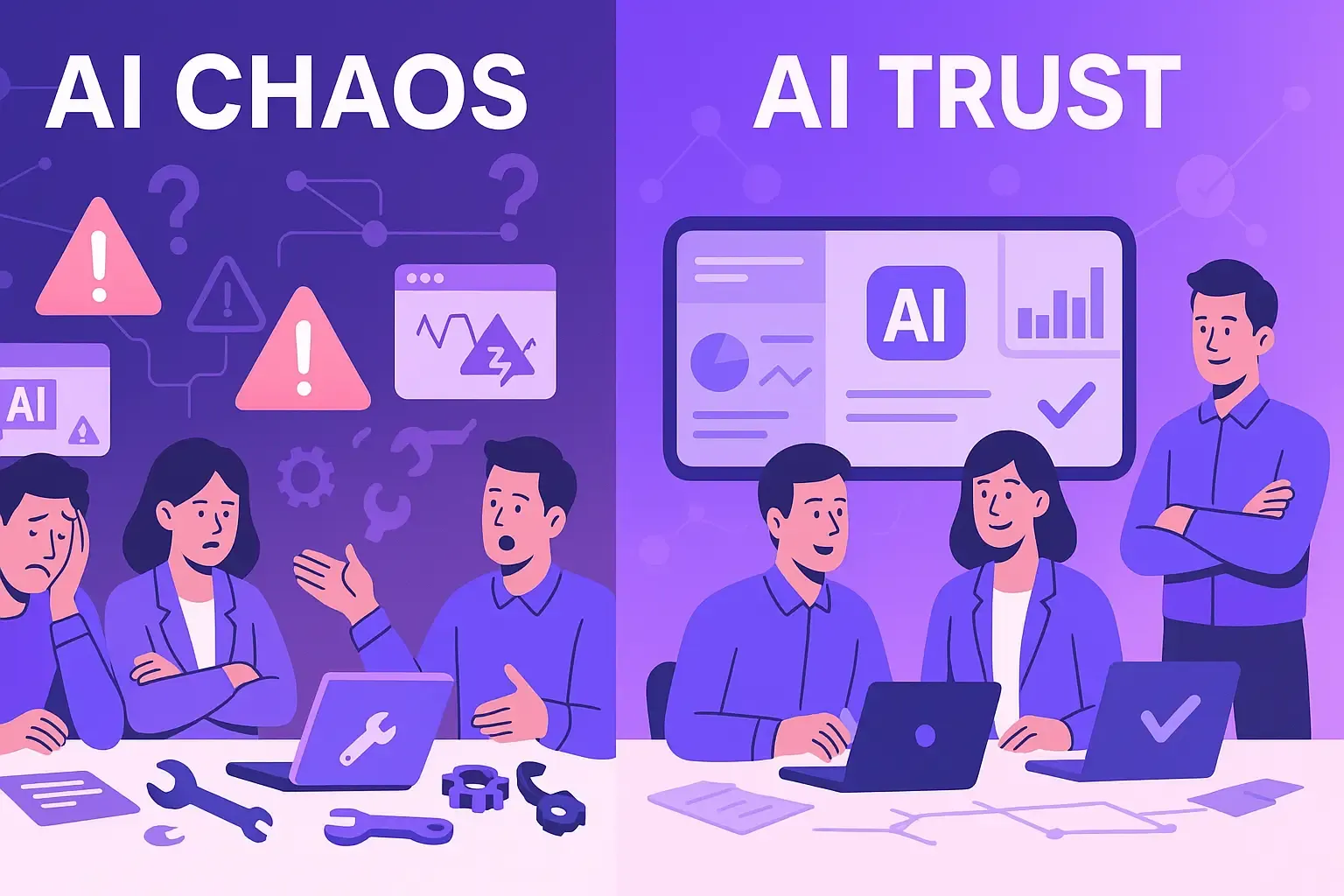
Your technical teams are quietly killing your AI initiatives. Not because they don't understand AI — because they understand it better than you do.
While you're focused on competitive advantage and market opportunity, they're seeing the operational reality: AI projects fail at rates between 50-80%, significantly higher than traditional software projects. They know what happens when mission-critical systems fail unpredictably. They've seen the aftermath.
Your competitors who are shipping AI features faster than you? They're either lucky, reckless, or they've solved the trust problem you're ignoring.
The Real Failure Statistics You're Not Hearing
The AI vendor pitch deck shows success stories. Here's what they don't show:
of AI pilots never reach production (we covered this in Part 1)
of AI projects end in complete failure according to recent enterprise surveys
higher AI failure rates for companies with technical team resistance
Your technical teams aren't being difficult — they're pattern-matching against catastrophic failure rates they've witnessed firsthand.
Why Smart Companies Are Losing the AI Race
Every month you spend in "AI strategy planning" while your technical teams raise concerns is a month your competitors are pulling ahead. But rushing past their objections guarantees joining the 80% failure club.
The companies winning at AI didn't skip the trust problem — they solved it first. They understood that technical team resistance is the canary in the coal mine, warning you about operational gaps that will destroy your AI initiatives.
The Trust Deficit Tax
When technical teams don't trust AI systems, you pay a hidden tax on every initiative:
- ✦Development velocity slows by 60-80% because every decision requires extensive review
- ✦Quality teams become bottlenecks because they can't debug AI-driven issues
- ✦Rollouts stall indefinitely because no one wants to be responsible for unpredictable systems
- ✦Innovation stops because teams won't build on foundations they don't trust
Meanwhile, your competitors with trusted AI systems are iterating weekly while you're still debating governance frameworks.
The Assessment That Actually Predicts Success
Traditional AI readiness assessments ask about strategy, governance, and use cases. They miss the operational questions that determine whether your AI will work in production or join the failure statistics.
We built our AI Trust Assessment after watching dozens of companies fail for predictable reasons — reasons their own technical teams could have identified if anyone had asked the right questions.
Operational Blind Spots That Kill AI Projects
- Can you trace AI decisions when they go wrong?
- Do you have rollback procedures for AI-driven processes?
- Can your current teams debug AI-specific failures?
Integration Reality Checks
- Will AI systems work with your existing security and compliance procedures?
- Can your incident response handle AI-related issues?
- Do you understand the ongoing maintenance requirements?
The Trust Multiplier Score
Your Trust Multiplier Score predicts whether your technical teams will accelerate or sabotage your AI initiatives. Companies with high Trust Multiplier Scores deploy AI 3x faster and see 60% higher success rates.
Companies with low scores? They join the 80% failure club.
The Questions Your Competitors Already Answered
While you're debating AI strategy, ask yourself:
Debugging Reality:
- ?When your AI system makes a wrong decision, how long until your team can identify why it happened?
- ?Can your current engineers fix AI problems, or do you need to hire specialists?
Operational Confidence:
- ?Would your technical teams bet their quarterly bonus on an AI system working correctly?
- ?Can you explain AI behavior to auditors, customers, and stakeholders who aren't data scientists?
Competitive Speed:
- ?How quickly can you deploy AI improvements compared to your fastest competitor?
- ?Are your technical teams proposing AI enhancements or finding reasons why "it won't work"?
If you can't answer these confidently, you're not ready for production AI — and your technical teams know it.
Your Standard IT Playbook Is Now Obsolete
For decades, we've managed IT projects with a standard playbook built on predictable, deterministic systems. That playbook is now dangerously obsolete. AI is probabilistic. It doesn't always produce the same result, and it operates with a degree of uncertainty that makes your existing controls irrelevant.
You see the symptoms of this everywhere:
- Unclear Metrics: Your team can't agree on what "success" looks like because you lack the tools to measure the business impact of a non-deterministic system.
- Endless Pilots: Projects get stuck in "notebook la-la land" because moving from a proof-of-concept to a secure, governed production environment seems impossibly complex.
- Unmanaged Expectations: Leadership expects magic, while the technical teams who have to manage the risk see a black box they can't control or explain.
Trying to solve these issues with more status meetings or clearer requirement documents is like trying to fix a faulty engine by repainting the car. You're addressing the surface, not the core mechanics.
You Can't Fix a Problem You Don't Measure
The trust deficit feels like a cultural issue, but it's rooted in very real operational gaps. To fix it, you first have to get an honest, data-driven look at where those gaps are.
That's precisely why we built the Generative AI Maturity Index.
We designed this assessment to move beyond high-level strategy and quantify the specific operational capabilities that create—or destroy—trust. It allows you to replace guesswork with governance. When you see your scores, you'll know exactly where the risk lies:
- Is your Measurement & ROI score low? If so, you will never escape the cycle of pilots with unclear business value. You are funding science projects, not business solutions.
- Is your Enablement & Scalability score low? This means your teams cannot securely build and deploy their own AI tools. AI is something that happens to them, not something they own, guaranteeing resistance.
- Is your Agent Orchestration & Control score low? This is the core of the "black box" problem. It means you lack a unified framework to manage, audit, and direct your AI agents, leaving you exposed to unpredictable behavior and vendor lock-in.
A low score in any of these categories is a mathematical measure of your trust deficit. It is the leading indicator of project failure.
The Anatomy of a Trustworthy AI Operation
So, what does "good" look like? Companies that successfully deploy AI at scale aren't just buying better tools; they're building a fundamentally more trustworthy operational framework.
They don't just "hope" for ROI; they have enterprise-wide AI scorecards and reporting dashboards that track performance by team and use case, just as they would any other critical business function.
They don't "Stall" in deployment; they provide full self-service capabilities with governance, allowing teams to build and scale solutions within a secure, pre-approved framework.
They don't "Accept" black boxes; they build for real-time behavioral adaptation and full audit traceability, giving them complete control over how agents learn and a clear record of every action taken.
This isn't a futuristic ideal. This is the new table stakes for enterprise AI. It is the operational harness that makes AI trustworthy, scalable, and profitable.
Ready to turn technical resistance into AI competitive advantage?
Your technical teams' concerns are valid — but the solution isn't hiring more AI specialists or waiting for perfect governance frameworks. You need operational expertise that understands both the technology and the enterprise reality.
PromptOwl's technical teams have built trustworthy AI systems for enterprises facing these exact challenges. We know how to bridge the gap between AI capabilities and operational requirements because we've solved the trust deficit problem dozens of times.
The Brutal Truth About AI Trust
Your technical teams' resistance isn't the problem — it's the symptom. The problem is that most companies try to deploy AI without the operational foundation to make it trustworthy.
You can continue debating AI governance while your competitors ship AI features. Or you can solve the trust problem first and deploy AI at competitive speed with technical team confidence.
The silent resistance from your teams and the endless cycle of failed pilots are mathematical indicators of operational gaps, not cultural problems. Fix the foundation, and the trust follows. Ignore it, and join the 80% failure club.
Your competitors aren't waiting for perfect AI governance frameworks. They're building trustworthy operational systems that let them move fast while you're still planning.