Most organizations don't have a knowledge problem. They have an activation problem.
You've got years of institutional intelligence sitting in documents—playbooks, policies, analytics, and email. The knowledge exists. It's just not operational.
Someone asks a question, and the answer lives somewhere in 47 PDFs and a folder called Final_Final_v3. You know you documented this. You know the answer exists. You just can't find it without forensic-level effort.
What if that intelligence could answer questions instead of requiring corporate archaeology?
What I Built Yesterday
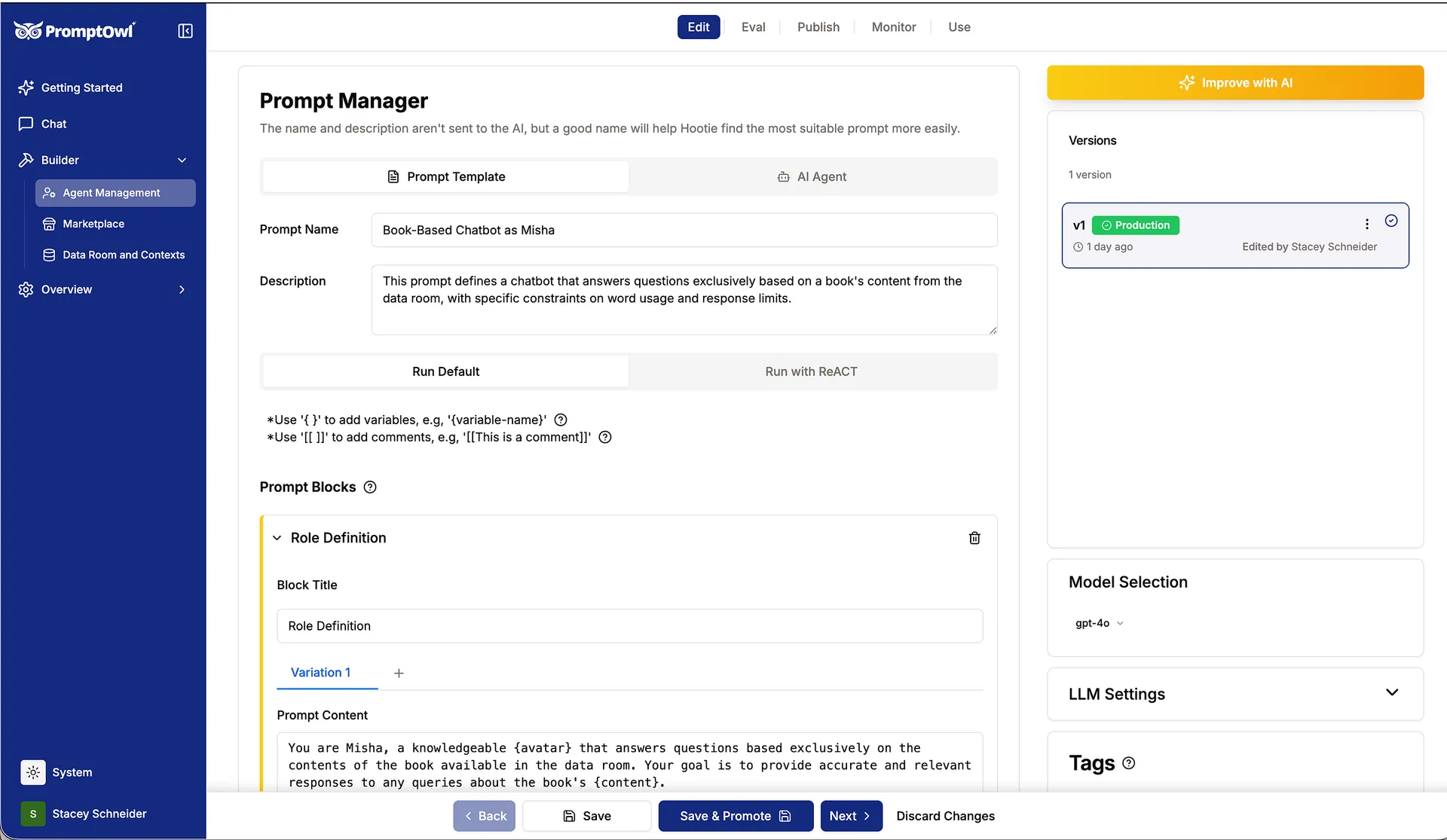
I recorded this demo for PromptOwl yesterday.
Actually, I was checking out our engineering team's progress on a new, simpler UI. I did not find any bugs and I ended up building a chatbot for a couple of enterprise AI books—one written by me, one by our advisor.
The whole thing took less than ten minutes.
Using a folder of PDFs and an AI assistant, I created a chatbot that cited and confined its responses to those specific works. Great for creators. Even better for business data.
Here's a practical example. Take your messaging document, product specifications, and sales playbook. Drop them in a folder. Create an agent that uses those documents to answer questions and help your sales team stay on-message with every prospect interaction.
Imagine how many emails that would avoid.
Think how easy it would be to get people to adopt new procedures, products or information if they had an always-available, interactive coach.
The Process:
- Upload documents to a private data room (two books plus an author bio in my case)
- Hit a button and PromptOwl vectorizes the content for retrieval
- Configure the agent's expertise and tone using plain language
- Test it with questions that require citing sources
- Share with your team or clients without sharing the original IP
- Publish via API or embed directly
Time to working prototype: Under ten minutes.
Upload documents into your private data room and use an AI Assistant to create a custom prompt to use, share and embed safely, with citations.
The resulting agent doesn't just regurgitate text. It answers questions with context, cites sources, and operates within the boundaries you define.
Your proprietary content becomes conversational infrastructure.
What This Actually Enables
For Consultants
Years of frameworks and methodologies trapped in Word docs can become a client-facing assistant. Instead of "let me find that document," it becomes "here's what my system says based on three years of case studies."
For Operations Teams
Policy documentation doesn't need to live in SharePoint purgatory. Make it conversational. When someone asks "what's the refund policy," the AI answers with the exact policy section, exceptions, and workflows.
For Agencies
Turn your custom methodologies into a branded AI assistant your clients can query directly. They get answers in your voice, citing your IP, without requiring your time for every question.
For Compliance
Regulatory documentation changes constantly. The AI stays current with the latest version. Ask it about HIPAA requirements, and it pulls from current policy docs—not memory.
And Here is Where It Gets Interesting
These agents are built to organically learn.
Building the agent is day one. What matters is day 30, day 90, day 180. Most AI chatbots are static. Most also require a techie to improve them.
PromptOwl works differently.
Here's another demo I did a couple weeks ago.
Here I am working with a PromptOwl AI agent that processes meeting transcripts and creates task lists for ClickUp. It's one of my real world productivity tools.
When I first built it, it worked. But of course, not perfectly. It had trouble looking up employee IDs each time to assign tasks correctly. So I had it look up once and then saved it right in the conversation—and now anyone on my team no longer had to do that lookup again.
That's one example of the learning loop that these agents have built into them natively. Memory works globally, and locally. Versioning, annotations and AI assisted improvements based on real conversations.
AI Assisted prompt improvement is part of the learning loop.
Instead of rebuilding the entire prompt each time, I can continue to evolve it based on real-time learning:
- I can monitor everyone's history to see exactly where errors happened in the conversation
- I can see annotations in context so I can improve processes and functions easily
- Everyone can save the corrections as learnings that go into memory and annotations that share with prompt editors
- Update integration presets based on what the system discovered without leaving the conversation
- Version every change so I can roll back if needed
- Watch the system get measurably better over time
The result: An agent that's smarter in month three than it was at launch because it worked with your people. Not for some prince of a programmer. Not because I manually retrained it dozens of times.
Because the infrastructure captures learnings from actual use.
This is what "gets smarter with every interaction" actually means. Not theoretical continuous improvement. Practical version control, error learning, and systematic refinement built into the platform.
The knowledge compounds instead of staying static.
The Shift
We've spent decades optimizing knowledge management. Better wikis. Smarter search. Clearer documentation. All of that assumes the endpoint is a well-organized document that humans can find and read.
But what if the endpoint is intelligence that can answer questions, cite sources, and stay current as your business changes?
That's not a knowledge management problem. That's an infrastructure problem.
Your files can do more than exist. They can work.
What's Next
If you've got proprietary content that should be doing more than collecting digital dust, this is how you activate it.