Start here · in plain terms
How ContextNest fits your AI stack
You don't replace your AI. ContextNest sits underneath it as the layer that decides which knowledge your AI is allowed to use, at which version, approved by whom — and records every answer's paper trail. Your voice agent, chatbot, or copilot stays exactly where it is; it just starts pulling from a governed source instead of a free-for-all.
Where ContextNest sits — the governed layer between your knowledge and your AI
Executive Summary
Every customer-facing AI agent is only as good as the context it retrieves. Today that retrieval is a black box: vector search returns different passages on identical questions, no one can explain why an answer was produced, and the knowledge behind it is owned by no one and approved by no one. Tolerable for a casual chatbot. For a customer-service or voice-AI operation — where a wrong answer is a refund, a compliance breach, or a churned account — it is a liability waiting to surface.
ContextNest is the governed engine that sits underneath those agents. It replaces probabilistic, unaccountable retrieval with deterministic, governed, fully auditable context delivery — without forcing you to replace the AI tools you already use.
1. Retrieval you can't reproduce, explain, or govern
Modern AI agents lean on vector / RAG retrieval. It's flexible, but it has three properties that are unacceptable for regulated, customer-facing work:
- It's non-deterministic. Ask the same question twice and you can get a different set of source documents — with no change to the data.
- It's unauditable. When an answer is wrong, there is no chain of custody. Who approved this content? What version was live when the customer was told X?
- It's ungoverned. The knowledge an agent draws on is usually a pile of documents no single person owns, reviews, or signs off.
For a customer-service organization heading into a stricter regulatory environment — the EU AI Act and adjacent frameworks make traceability and human oversight a procurement requirement, not a nice-to-have — this is the gap that blocks AI from moving past pilot into production.
2. A governed engine, not another database
ContextNest treats organizational knowledge as a managed, governed asset — portable context that survives model changes, vendor switches, and staff turnover. It sits beneath your agents as the retrieval engine, so the intelligence layer stays yours and swappable while the knowledge layer stays governed and constant.
Two swappable layers, one constant engine
3. Deterministic retrieval, full stop
For the highest-stakes paths, ContextNest offers something no vector store can: you can skip the index/sync layer entirely and use `ctx` for deterministic retrieval, full stop. Same question, same governed answer, every time — provably reproducible.
How a fact becomes a trusted answer — the governance flow
The governance plane decides what context is eligible; the runtime plane records what context was consumed. A nightly agent keeps the nest current by proposing updates — nothing goes live without steward approval. Adapted from Context Nest: Verifiable Context Governance for Autonomous AI Agents (Fig. 2).
Executive Summary
Every customer-facing AI agent is only as good as the context it retrieves. Today that retrieval is a black box: vector search returns different passages on identical questions, no one can explain why an answer was produced, and the knowledge behind it is owned by no one and approved by no one. Tolerable for a casual chatbot. For a customer-service or voice-AI operation — where a wrong answer is a refund, a compliance breach, or a churned account — it is a liability waiting to surface.
ContextNest is the governed engine that sits underneath those agents. It replaces probabilistic, unaccountable retrieval with deterministic, governed, fully auditable context delivery — without forcing you to replace the AI tools you already use.
The result: lower cost, better outcomes, great controls, real usability — the substrate that lets a customer-service org trust its AI, and prove that trust to an auditor.
1. Retrieval you can't reproduce, explain, or govern
Modern AI agents lean on vector / RAG retrieval. It's flexible, but it has three properties that are unacceptable for regulated, customer-facing work:
- It's non-deterministic. Ask the same question twice and you can get a different set of source documents — with no change to the underlying data. In ContextNest's own testing, standard vector search returned different results on 80% of identical, repeated questions; in the worst case, two runs of the same question agreed on barely a fifth of what they pulled. An agent on that foundation cannot promise a consistent answer to a customer — or a regulator. (The measurement detail is in §3 and the appendix.)
- It's unauditable. When an answer is wrong, there is no chain of custody. Who approved this content? What version was live when the customer was told X? Vector stores don't carry that lineage.
- It's ungoverned. The knowledge an agent draws on is usually a pile of documents no single person owns, reviews, or signs off. Stale, contradictory, unapproved content flows straight into customer answers.
For a customer-service organization heading into a stricter regulatory environment — the EU AI Act and adjacent frameworks (NIST AI RMF, ISO/IEC 42001) make traceability and human oversight a procurement requirement, not a nice-to-have — this is the gap that blocks AI from moving past pilot into production.
2. A governed engine, not another database
ContextNest treats organizational knowledge as a managed, governed asset — portable context that survives model changes, vendor switches, and staff turnover. It sits beneath your agents as the retrieval engine, so the intelligence layer stays yours and swappable while the knowledge layer stays governed and constant.
Lower cost — up to 3× cheaper retrieval
ContextNest retrieves by governed selector: it pulls the specific, approved context that answers a question rather than over-fetching a wide net of matches and paying to process all of it. In a controlled test, the selector answered at the same quality while using ~3× fewer input tokens than a standard keyword-search baseline.
Token cost per query, selector vs. a standard retrieval baseline. On a pristine test corpus both methods answer at essentially the same quality (a 0.80 vs 0.90 pass rate that is within noise on a 10-question fixture) — the selector simply does it with a third of the input tokens. The selector's accuracy advantage only emerges once the knowledge base contains stale, superseded, or contradictory content — which every real enterprise corpus does. Full method: Context Nest: Verifiable Context Governance for Autonomous AI Agents (Table 8).
Better outcomes — #1 on governance
Across the realistic alternatives — RAG (sparse or dense), knowledge graphs, and Git-style version control — only ContextNest covers the full set of governance properties a regulated CS operation needs. Because only published, steward-approved versions are ever retrievable, answer quality holds up as the knowledge base scales instead of decaying into contradiction.
| Governance property | RAG | Knowledge graphs | Git | ContextNest |
|---|---|---|---|---|
| Provenance | ✗ | ~ | ✓ | ✓ |
| Version identity | ✗ | ✗ | ✓ | ✓ |
| Integrity | ✗ | ✗ | ✓ | ✓ |
| Deterministic selection | ✗ | ✓ | n/a | ✓ |
| Traceability | ✗ | ✗ | ✗ | ✓ |
| Temporal consistency | ✗ | ✗ | ✓ | ✓ |
| Knowledge preserved | ✗ | ✗ | ✓ | ✓ |
| Semantic retrieval | ✓ | ✓ | ✗ | ~ |
Context-governance properties across approaches. ContextNest is the only approach that satisfies traceability at all, and the only one pairing it with deterministic selection and integrity. Source: Context Nest: Verifiable Context Governance for Autonomous AI Agents (Table 14). (Semantic retrieval is available via optional hybrid mode.)
Great controls — a complete governed workflow
ContextNest ships the full stewardship loop out of the box:
- Stewards own and approve. Every node has an accountable owner; changes move through approval before going live.
- Fully auditable & traceable. Every change is hash-chained and versioned — a tamper-evident record of who changed what, when, and why.
- Version history. Roll back to any prior state; see exactly which version was live at the moment any answer was given.
- Comment threads. Discussion and rationale live on the knowledge itself, so the "why" never gets lost.
This is the chain of custody that turns "the AI said it" into "here is the approved source, the version, the owner, and the timestamp" — the difference between hoping you pass an audit and proving it.
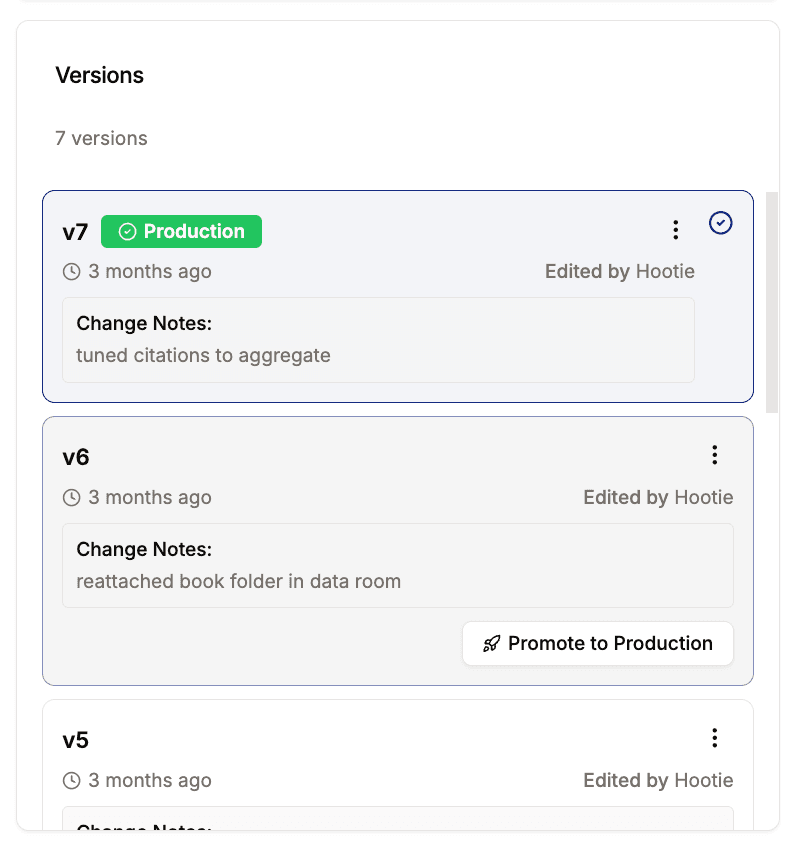
Each version records who changed it, when, and which version agents are allowed to consume (the "AI-active" published version). Roll back to any prior state and see exactly what was live at the moment any answer was given.
Stewardship + usability — govern it however you work
Governance fails when it forces people into one console. ContextNest meets stewards where they are — on the community nest, agentically through the app, or with any AI they already use. And it runs continuously: a nightly agent collects new information, reconciles it against the existing nest, and proposes recommended changes — which stewards review and approve.
Concretely: the agent runs on your configured model (Claude by default), reads new and changed sources, and drops its proposals into the steward's review queue as suggested edits — each one a diff against the current published version, with a plain-language rationale and a link to the source it came from. The steward sees exactly what would change and why, and clicks approve, edit, or reject. Nothing the agent writes is ever live, or retrievable by another AI, until a human approves it. The knowledge base curates itself toward correct; humans keep the final say.

One server, many governed nests — each connectable from the CLI, Claude Desktop, or the PromptOwl app. Stewards manage knowledge here or agentically; agents read from it over MCP. The same governed source serves your whole team and every AI they run.
3. Deterministic retrieval, full stop
For the highest-stakes paths, ContextNest offers something no vector store can: you can skip the index/sync layer entirely and use ctx for deterministic retrieval, full stop. Same question, same governed answer, every time — provably reproducible.
Determinism evaluation, 1,060-document synthesized corpus, 50 queries × 20 repetitions per method. Selector and BM25 were perfectly deterministic (mean Jaccard 1.000) on every query; dense + HNSW scored mean Jaccard 0.611 and diverged on 40 of 50 queries. Source: Context Nest: Verifiable Context Governance for Autonomous AI Agents (Table 11).
For customer-service operations that have to give the same correct answer to every customer — and stand behind it in an audit — determinism isn't a feature. It's the requirement.
What governance prevents: the stale-version failure
Cost is what governed selection saves; correctness under pressure is what it prevents losing. This is the failure mode every real knowledge base carries — old, superseded, contradictory content sitting alongside the current truth. We reproduced it directly: we seeded a corpus with archived "v2" entries that contradict the current published versions on specific facts, then asked 30 questions whose correct answers live only in the current version. A retrieval system that indexes the raw storage layer can surface the stale, wrong version. The governed selector — which returns only published content — cannot.
Stale-version scenario, 30-question suite, three retrieval conditions. The governed selector wins on both axes at once — higher pass rate and lower token cost than either keyword-search condition — because it never surfaces superseded versions in the first place. Source: Context Nest: Verifiable Context Governance for Autonomous AI Agents (Table 9).
4. Why now, and why customer service
- Regulation is arriving. EU rules raise the bar on traceability and human oversight of AI. Governance moves from differentiator to gating requirement — and ContextNest is built for it.
- CS is the highest-volume, highest-risk AI surface. Voice and chat agents touch thousands of customers a day; one bad retrieval scales instantly. Deterministic, auditable context is how you deploy at that volume without taking on that risk.
- The tooling has caught up. ContextNest delivers governance as infrastructure — an engine that slots under the AI stack you already run, rather than a rip-and-replace.
5. How it deploys
ContextNest is the backend governed engine, so it integrates beneath your existing agent rather than competing with it — including voice-AI platforms such as getvocal.ai, the first partner in the ContextNest reseller network:
- Connect your knowledge into a governed nest; stewards take ownership.
- Slot ContextNest in as the retrieval layer under your current agent or voice platform.
- Choose your mode — governed semantic retrieval for breadth, or deterministic
ctxretrieval for the answers that must be reproducible. - Govern continuously — stewards approve, the nightly agent proposes, the audit trail accrues automatically.
The Community Edition — where governance happens
The Community Nest is your self-hosted governed vault. It's where your knowledge lives under version control, where stewards approve what your AI is and isn't allowed to read, and where the audit trail starts. Connect it to Claude Desktop, the PromptOwl app, or any MCP client — and every AI you run starts pulling from a governed source. Free. One command.
npx @promptowl/contextnest-community
- Run the command above — the server starts on
localhost:3838. - Open app.promptowl.ai, grab your free Community License key, and paste it in.
- Import your first vault — your stewards own it from there.
Lower cost. Better outcomes. Great controls. Real usability.
The substrate your AI can be held accountable to. For a governed-engine deployment scoped to your customer-service or voice-AI operation — SSO, dedicated support, and rollout help — ContextNest is available through our reseller network.
Appendix A · Evidence at a glance
All figures below are drawn from Context Nest: Verifiable Context Governance for Autonomous AI Agents. Full methodology, corpora, and evaluation harness are available in the paper.
A · Token cost (Experiment E1 & stale-version scenario)
| Method | Avg. input tokens | Pass rate | Test |
|---|---|---|---|
Selector (ctx resolve) | 217 | 0.80 | E1 (clean corpus) |
| BM25 (k=3) | 644 | 0.90 | E1 (clean corpus) |
Selector (ctx resolve) | 215 | 0.97 | Stale-version scenario |
BM25 leaky (indexes .versions/) | 655 | 0.93 | Stale-version scenario |
| BM25 clean (published only) | 725 | 0.90 | Stale-version scenario |
B · Retrieval determinism (1,060-doc corpus · 50 queries × 20 reps)
| Method | Mean Jaccard | Min Jaccard | Perfectly deterministic | Non-deterministic |
|---|---|---|---|---|
Selector (ctx resolve) | 1.000 | 1.000 | 50 / 50 | 0 |
| BM25 (k=3) | 1.000 | 1.000 | 50 / 50 | 0 |
| Dense + HNSW (efSearch=4) | 0.611 | 0.210 | 10 / 50 | 40 / 50 (80%) |
C · Governance property coverage
ContextNest is the only approach covering provenance, version identity, integrity, deterministic selection, traceability, temporal consistency, and knowledge preservation simultaneously (full matrix in §2). RAG = sparse and dense retrieval pipelines; KGs = knowledge graphs.
Appendix B · References & sources
Standards, protocols, and prior work cited in the ContextNest technical paper (selected; full bibliography of 34 works available on request).
- European Parliament. Regulation (EU) 2024/1689 — Artificial Intelligence Act. Official Journal of the EU, 2024. eur-lex.europa.eu
- NIST. AI Risk Management Framework (AI RMF 1.0). NIST AI 100-1, 2023. nist.gov
- ISO/IEC. ISO/IEC 42001 — Information technology · Artificial intelligence · Management system. 2023. iso.org/standard/42001
- OWASP. OWASP Top 10 for Large Language Model Applications, v1.1. 2023. owasp.org
- Anthropic. Model Context Protocol specification. 2024. modelcontextprotocol.io
- OpenTelemetry / CNCF. What is OpenTelemetry? 2025. opentelemetry.io
- Lewis et al. Retrieval-Augmented Generation for Knowledge-Intensive NLP Tasks. NeurIPS 2020.
- Edge et al. From Local to Global: A Graph RAG Approach to Query-Focused Summarization. arXiv:2404.16130, 2024.
- Chen et al. Benchmarking Large Language Models in Retrieval-Augmented Generation. AAAI 2024.
- Izacard et al. Unsupervised Dense Information Retrieval with Contrastive Learning. TMLR 2022.
- Ji et al. A Survey on Knowledge Graphs. IEEE TNNLS 33(2), 2022.
- Buneman et al. Why and Where: A Characterization of Data Provenance. ICDT 2001.
- Green, Karvounarakis & Tannen. Provenance Semirings. PODS 2007.
- Groth & Moreau. PROV-Overview (W3C Working Group Note). 2013.
- Gebru et al. Datasheets for Datasets. CACM 64(12), 2021.
- Mitchell et al. Model Cards for Model Reporting. FAT* 2019.
- Merkle. A Digital Signature Based on a Conventional Encryption Function. CRYPTO '87, Springer.
- Rundgren, Jordan & Erdtman. JSON Canonicalization Scheme (JCS). RFC 8785, IETF, 2020. datatracker.ietf.org/rfc8785
- Torvalds. Git: A Distributed Version Control System. 2005. git-scm.com
- Konsynski et al. Cognitive Reapportionment and the Allocation of Decision Rights. JMIS 41(2), 2024.
Additional sources in the full paper:Bordes et al. (NeurIPS 2013), Nogueira & Cho (2019), Press et al. (EMNLP Findings 2023), Kuprieiev et al. (DVC), Treeverse (LakeFS), Moreau et al. (Open Provenance Model), Elofson & Konsynski (JMIS 1991), Fjeldstad & Konsynski (ICIS 1986), Google Cloud AP2 (2025), Mastercard Agent Pay (2025), Nottingham & Wilde (RFC 7807).