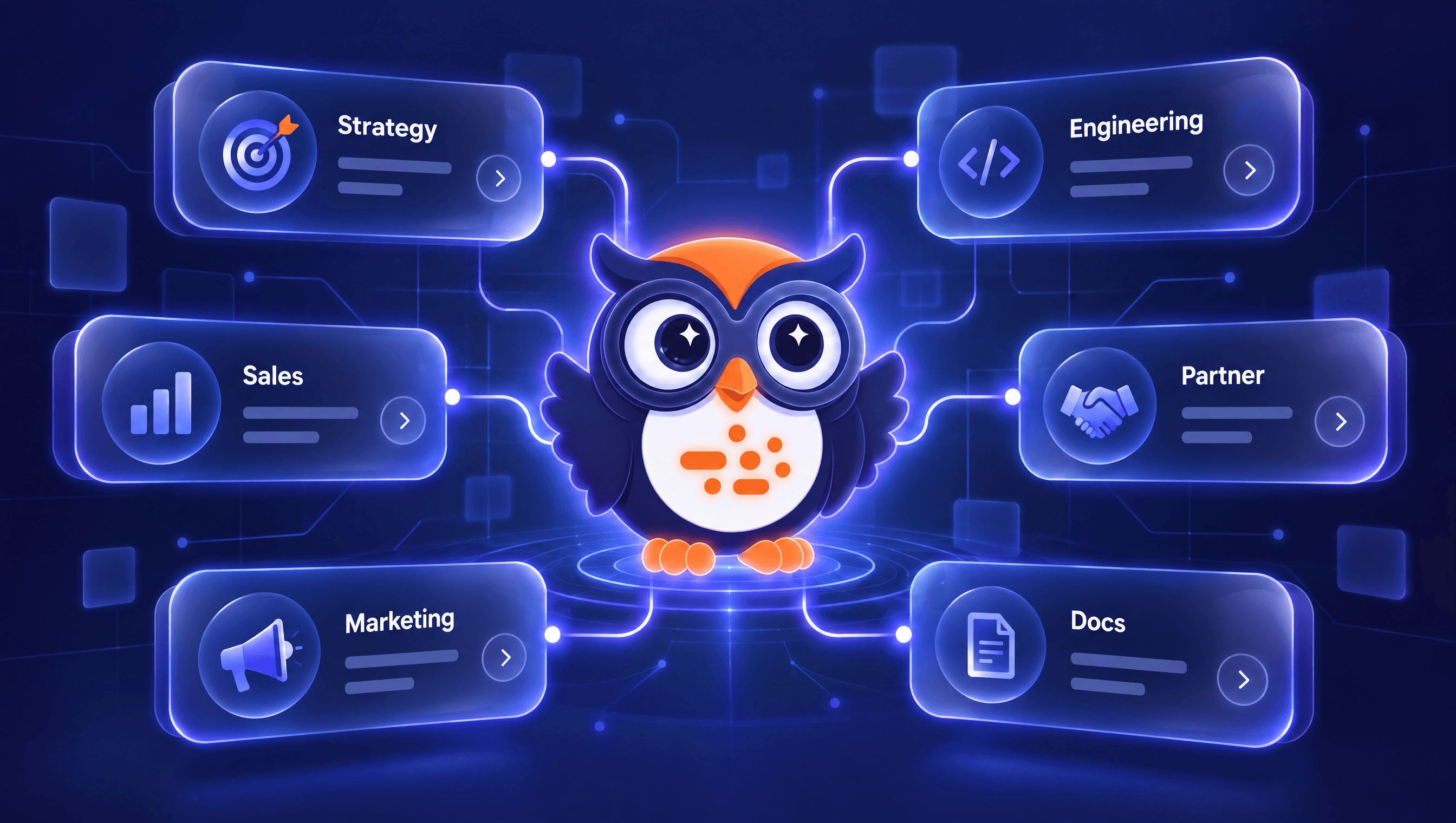
Most people who use ContextNest end up with more than one nest. That's normal — the separation is the point, not a mistake to eventually undo.
At PromptOwl, we run it that way ourselves — separate nests for our own teams, plus an isolated nest for every partner. Until today, using more than one of them meant picking a single nest before you'd even asked your question.
Every Nest Still Has a Reason
The separation exists for two reasons: who gets to see it, and how it gets used.
Our Engineering nest has its own rules and automations, so the team can collaborate and automate with confidence — nobody outside engineering needs to be in there. Our Strategy Vault holds the business thinking: our copy standards, our SOPs, a running summary of every daily standup, so it stays in tune with what the humans actually decided. Our Documents nest is the one we open up to everyone, so any user's AI can plug straight into our docs. Each partner gets their own isolated nest on top of all of that — scoped to them, visible to them, and to nobody else.
None of that changes. The nest is still the unit of visibility and governance. What used to be the problem was doing anything with more than one of them at the same time.
We Made Discovery the System's Job
Connecting to a nest used to mean choosing one for the whole conversation, before you'd even asked your question. Now Claude traverses across every nest you're connected to as your question calls for it — your partner nest when the answer's there, your engineering nest when it's there — without you deciding in advance which one to point at.
One connection your AI reads every nest through — it picks the right one for each question.
Each nest still collects its own context, stewards it under its own rules, and enforces its own visibility. That doesn't change. What changes is that you, as one person, can draw on all of it together instead of committing to a single nest before you start typing.
Under the hood, ContextNest enumerates every nest you own, every nest shared with you, and every public nest you can see, merged into one list behind a single connection. Your partner nest is still scoped to that partner. Your engineering nest still stays out of a partner's hands. One connection changes the door. It doesn't touch the walls behind it.
One Connection. Every Nest, Every Time.
Setup is one screen, done once. Paste in the API key you already use — any key you've got works across every nest you can see — and you're connected. There's no reconnecting mid-conversation, no picking a nest first, and nothing to repeat to your AI each time you start a new chat. Connect once, and it stays connected.
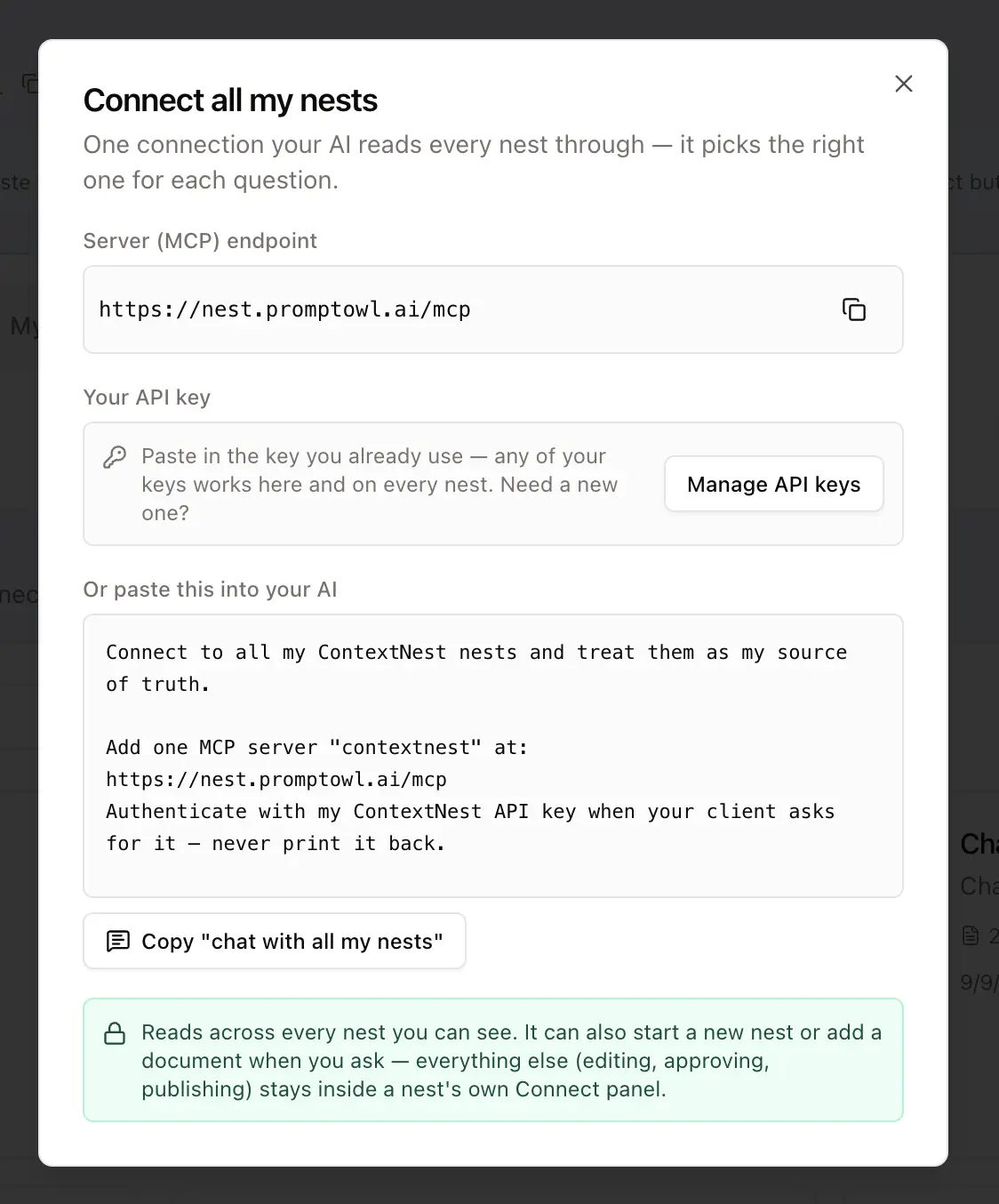
If you'd rather skip the manual setup, ContextNest also hands you a ready-made prompt to paste into your AI client that does the same one-time connection for you. However many nests you have today, and however many you add later as you bring on new partners, this is still the only setup step — done once, not once per nest.
The fastest way to feel this is to build a nest and watch it show up automatically the next time you connect. Magic Context walks you through that first one end to end — it reads whatever you point it at, organizes it, and hands it back as something your AI can query. Nothing about that setup is specific to a first nest, either. The same flow is what you'd use to spin up a second one, a tenth, or a brand-new partner's.
Published September 11, 2026 · Stacey Schneider